Wednesday, 28 January 2009

HOW TO GROW SPECIES TULIPS FROM SEED


CLICK HERE FOR THE NEW 'GARDEN OF EADEN’ WEBSITE AND SEED SHOP

When it comes to types of tulips you will find that most of what is available in plant retail outlets are hybrids. This means that they are the result of deliberate cross breeding, a technique used by plant breeders to help enhance and stabilise favoured characteristics. In order to build up stocks as well as to maintain these characteristics from generation to generation it becomes necessary to vegetatively propagate them by either using offset bulbs or micro-propagation. Propagating cross-bred plant stock by seed unfortunately produces mixed results as the hybridization technique will result in seedlings that have mixed combinations of the characteristics demonstrated by either or both parent plants.

Fortunately, this isn't the case when it come to growing species tulips from seed as this group of plants do not easily cross pollinate with other tulip species. In some cases - such as Tulip wilsoniana - the flowers are hermaphrodite and able to pollinate and produce viable seed amongst themselves.

Once the flowers of your species tulip has been pollinated it is just a matter of waiting for the seed and seed pods to form and mature. Once the pods turn brown they are ready to remove. If you catch the seeds as soon as they ripen it's possible to get away with planting them immediately into pots using a free draining seed compost. For alpine varieties, sow the seeds on top of the compost, covering with a thin layer of horticultural grit, water, then leave in a cold-frame to germinate. For other varieties, cover with a thin layer of compost of no more than 1cm. Some varieties such as Tulipa spengerii may still need to go through the winter before their seeds can germinate.

If you are late in picking the seed pods then the seed coats inside will naturally begin to harden and will need a period of dormancy before they can germinate. Carefully remove the pods and take them to a well lit and wind free environment such as a greenhouse or potting shed. Carefully open up the pods and remove the seeds - placing them on to a ceramic plate where they can be allowed to dry for a week or so. In their natural habitat tulip seeds will have two or three months of cold weather with which to break their dormancy , but you can replicate this by placing ripe seed in a damp paper towel enclosed in a plactic bag and leaving it in the fridge for a similar period. This is particularly important is you are in an area prone to mild or warm winters.

Once this period has finished, remove the seeds from the fridge and sow them on top of a good free-draining compost topped off with no more than 1cm of compost. Leave outside in a bright warm position or in a south facing cold frame. Seeds from different tulip species will germinate a different rates so be patient as could take anytime from a month up to a year before germination occures. Keep the pots watered over late spring and summer and once the new shoots have been growing for a couple of months feed once a week with a half normal dose of standard liquid fertiliser over the growing period. Plant out into open ground the following year.

For further information click onto:
How do you Harden off Seedlings?
How to Grow Aloe vera from Seed

Monday, 26 January 2009

HOW TO GROW LETTUCE FROM SEED


CLICK HERE TO VIEW THE NEW 'GARDEN OF EADEN' WEBSITE
.
Want to buy lettuce seed? Click here to view seed shop.

SOWING INDOORS OR UNDER GLASS

If you are without a heated greenhouse and you want to get off to an early start, you can sow your lettuce seed indoors. They will grow quickly, so you may wish to skip sowing them into seed trays and plant them directly into small pots or compartmentalized packs. Just make sure that you use containers that are large enough for the young plants to reach garden size without the need for potting on.

Fill your tray or container with John Innes seed and potting mix to within a half-inch of the rim, tapping them on the side to help settle the mix. Top up as necessary. If using pots or cells, place a few seeds into each one, then give a light covering of compost, firming it down gently over the seeds. If you are using a seed tray then give a light and even sprinkling of seeds across the whole tray at approximately 5 seeds per square inch. Once done, give a light covering of compost and water in. Label with the variety and date of sowing, and place in into a covered propagator making sure the vents are fully open. Now leave in a bright, warm room, out of direct sunlight. The more light they can receive the better germination you will get. Once the seedlings reach about 2 inches in height, thin out and discard any that look weak. Those in the seed tray can be pricked out and potted on into a standard potting mix. Those already in pots can be hardened off in preparation for moving outside.

.
If your seedlings were grown under glass then they will also need to harden off before going outdoors. Place them into a cold-frame but keep the lid closed for a couple of weeks. Afterwards the lid can be opened on dry frost free days but remember to shut it again at night. After a further week or so, or when frosts are no longer expected, leave the lid open day and night for a week before planting outside.

.To harden off seedlings that have been grown indoors in a heated room, moved them to a bright unheated room, leaving them there for a couple of weeks before either putting them into a cold frame, or for leaving them outside during the day. Never leave them out over night, and keep them in if there are strong cold winds of if temperatures drop below 6 degree Celsius. Keep this up for a week and if there is no immediate threat of further frosts they can be planted outside.
.
SOWING OUTDOORS

Lettuce plants require a free draining, humus rich soil that will hold plenty of moisture in the summer. To prevent the common physiological disorder of 'Tip burn' that can be experienced with some soils, you may wish to add lime before planting. In preparation to sowing, dig over the soil and add plenty of compost (such as leaf mould or well rotted manure) during the autumn or early winter. Then a week or so before sowing your lettuce seeds, rake the soil over to produce a fine tilth. You may also wish to apply a general fertiliser at this time.

Although Lettuce plants like plenty of light they do not like extremes of heat as this can also result in 'Tip burn'. Although your early seeded plants should be fine it's advisable to plant your summer harvest in a lightly shaded site.


When sowing spring lettuce seeds directly outside, wait until the worst of the frosts are over. Choose a sunny site but by sowing this early you may need to give them the protection of a small poly-tunnel. If you are starting them off into seed beds, sow the seeds very thinly in ½ inch deep drills but leave about 6 inches between each row. If you are sowing them directly into the open ground then leave between 10 and 12 inches between rows. To avoid having a glut of lettuce and to ensure that crops are regularly coming into harvest, make successive, smaller sowings of lettuce seeds, at 1 or 2 week intervals depending on how much you intend on using. Depending on the variety it can take anytime between 6 and 14 weeks from sowings to become ready for harvest, so if you are growing from packet seeds - always read the label.

Once the seedlings get to about 2 inches high they can be thinned out to leave a gap of about 6 to 12 inches between each plant- depending on the overall size of the variety grown. If you are planning on transplanting seedlings grown indoors into open ground then this is an ideal time to do this.

For further information click onto:
Growing Cucumbers form Seed
Growing Lettuce from Seed
How do you Harden off Seedlings?
How to Collect and Prepare Lettuce seeds for Propagation
How to Collect and Prepare Pea Seeds for Propagation
How to Collect and Prepare Sweet and Chilli Pepper Seeds for Propagation
How to Collect and Prepare Tomato Seeds for Propagation
How to Control Flea Beetles on Lettuce
How to Germinate and Grow Cucumbers from Seed
How to Germinate and Grow Melon Plants from Seed
How to Germinate and Grow Okra from Seed Indoors
How to Grow Aubergines From Seed
How to Grow Avocado from Seed
How to Grow Beetroot from Seed
How to Grow Carrots from Seed
How to Grow Celery from Seed
How to Grow Chinese Spinach from Seed
How to Grow Cucumbers from Seed
How to Grow Eggplants from Seed
How to Grow French Beans from Seed?
How to Grow From Seed
How to Grow Geraniums from Seeds
How to Grow Giant Onions
How to Grow Greenhouse Tomato Plants from Seed
How to Grow Lettuce Indoors
How to Grow Lettuce Outside
How to Grow Mushrooms
How to Grow Mushrooms at Home
How to Grow Okra from Seed Outdoors
How to Grow Outdoor Tomato Plants from Seed
How to Grow Peppers from Seed
How to Grow Radish from Seed
How to Grow Red Kidney Beans from Dried Seed
How to Grow Rocket from Seed
How to Grow Spinach from Seed
How to Grow Sweet Corn from Seed
How to Grow Tomatoes from Seed
How to Grow Vegetables?
How to Grow Winter Lettuce from Seed
How to Propagate and Grow Chili Peppers from Seed
How to Propagate and Grow Sweet Peppers from Seed
How to Propagate and Grow the Bell Pepper from Seed
How to Sow and Grow Courgettes from Seed Indoors
How to Sow and Grow Spring Onions from Seed
Organic Control of Aphids on Lettuce
Planting Lettuce Seed
Salad Crops for Late Summer/Autumn Planting
What is Crop Rotation?
What is a Seed?
WHAT IS AN F1 HYBRID?
Why haven't my Seeds Germinated?
Which Salad Crop Seeds can be sown in August?
Which Vegetable Seeds can be Sown in January?
Which Vegetable Seeds can be Sown in September

Wednesday, 21 January 2009

Tulipa 'Rems Sensation'


CLICK HERE FOR THE NEW 'GARDEN OF EADEN’ WEBSITE AND SEED SHOP

Reminiscent of the iconic 'Semper Augustus' tulip whose fame was legendary during the heady days of Dutch 'Tulipmania, this selected form of Tulipa 'Zurel' is truly an exceptional specimen.

With its strong, waxy petals, glistening white with purple/red flames, 'Rem's (short for Rembrant) Sensation' has its heritage amongst the 'Triumph' family of tulips which are particularly prized for their beautiful, traditional "tulip" flower shape. However unlike the popular 'broken' tulips of the Tulipmania period (Semper Augustus included) the broken colour of Rems sensation is a naturally stable form and not the result of a colour breaking, detrimental virus.

This eye-catching example requires little maintenance in the garden, and is one of the earliest to come into flower with large buds forming visibly as early as February. These are borne on tough, sturdy stems, which allows them to stand up well to bad weather, and not only do they make a fantastic addition to any garden they also make excellent cut flowers due to their long vase life.

You can expect to see them in full flower any time from March through to April, but unlike many of the Triumph tulips, 'Rem's Sensation' is a little on the short side growing to no more than 8 - 10 inches.
.
If you are buying tulip Rem's Sensation as pre-packed bulbs in the autumn, plant them in a sunny position and preferably into a free draining soil. They will need to go about 5-6 inches deep and if you are planting in clumps - around 5 inches apart. Try to aim for between 7-9 bulbs per square foot of ground.

For further information click onto:

SPECIES TULIP - Tulipa Wilsoniana


CLICK HERE FOR THE NEW 'GARDEN OF EADEN’ WEBSITE AND SEED SHOP

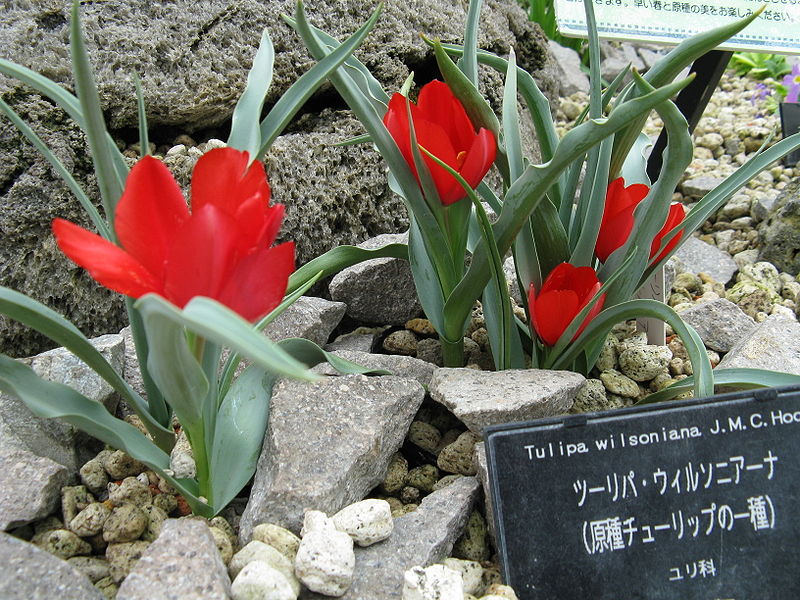
The Tulipa wilsoniana, or as it sometimes known as - Tulipa montana Lindley, is a specialty amongst species tulips and it is all down to its native habitat. Found on the mountains of Turkmenistan at a height of approximately 3000m, Tulipa wilsoniana is categorized among the group known as the'alpine tulips', and like all true alpines T. wilsoniana exhibits specific characteristics that has enabled them to survive in such harsh conditions.

The most noticeable and typical trait of all true alpine plants is to do with their flowers as they are almost always far larger than the size of their leaves - two inches across in the case of Tulipa wilsoniana. They have also evolved other modifications to tolerate the cold, drought and poor quality soils that the mountains have to offer. This is demonstrated by the bulbs thick, hard protective outer skin, and the woolly tip that help protect the apical bud from the worst of the mountain weather.

As strange as it may seem, these special modifications can also help theses plants deal with extremes of heat. This is because both environments suffer with a lack of available water (In its mountain environment water becomes unavailable during the winter period as it freezes) and as such, it has become a particular favorite of tulip-starved residents of Southern California. Although the weather in these harsh dry environments is unsuitable for flower initiation, you can enforcing a dormancy period on the bulb by placing it in the salad compartment of a household fridge. Leaving it there for 6 weeks or so will usually do the trick. However the change in habitat will create a far taller plant than the European norm of no more than 6 inches.

In the south of England you can expect to see the emergence of new succulent growth come January. These first few leaves are slow to progress but they eventually develop turning a pretty glacous colour caused by a grey-blue waxy surface. Mature leave will also display an ornamental ocillating edge. Unfortunately you will have to wait until at least the end of March for the flowers appear but it is worth the effort once the first deep vermilion red flowers with blue-black centres shows its face.

For further information click onto:
How to Grow Species Tulips from Seed
How to Over-Winter Rare and Species Tulips
How to Propagate Tulips
Lost Tulips of the Dutch Golden Age- Semper Augustus and Viceroy
Old, Broken and Unususal Tulip Varieties
Old Dutch Tulips - Tulip Duc van Thol 'Rose'
Old Dutch Tulips - Tulip Duc van Thol 'Scarlet'
Old Dutch Tulips - Tulip 'Lac an Rijn'
Species Tulip - Tulipa acuminata
Species Tulip - Tulipa Turkestanica
Top Tips For Tulip Care
Tulip diseases
Tulip History and Popular Varieties
Tulip 'Semper Augustus' - does it still exist?

SPECIES TULIP - Tulipa acuminata


CLICK HERE FOR THE NEW 'GARDEN OF EADEN’ WEBSITE AND SEED SHOP

Sometimes known as the 'Fire Flame' tulip or 'Turkish' tulip, the Tulipa acuminata is indeed a rare bulb to find. Growing to a height of between 12 and 18 inches it can create a stunning, almost tropical display from early to mid spring. Its long, narrow, scarlet and yellow petaloids sit high on delicate stems making it ideal for cut flowers but these delicate heirloom bulbs may need a little support if heavy winds or rain are due.

Although a species bulb, Tulipa acuminata is no longer found in its native habitat. Although catalogue dated to 1813, it is in fact belived to be the last survivor from the early 1700's when tulips like this were all the fashion in the Ottoman empire.

If you are lucky enough to get hold of a couple of specimens then they are relatively easy to care for. Plant them into a fertile, sandy soil situated in an open and sunny location; however they will need to be protected from excessive damp and strong winds. Once planted, give them a good top dressing and - unlike most cultivated varieties - Tulipa acuminata can be left in the ground and allowed to spread naturally. Once planted give them a good top dressing, and start to water your bulbs as soon as you see the buds beginning to rise. This will encourage larger blooms and taller stems. Allow the old foliage to dry off before cutting it back as this will allow most of the nutrients and carbohydrates to be absorbed back into the bulb proper in readiness for next years display.
.
For further information click onto:

Monday, 19 January 2009

HOW TO COLLECT AND PREPARE TOMATO SEEDS FOR PROPAGATION


CLICK HERE FOR THE NEW 'GARDEN OF EADEN’ WEBSITE AND SEED SHOP
.
Want to buy tomato seed? Click here to view seed shop.

Collecting seed from your favourite varieties of tomato has never been easier due to its all year round availability from supermarkets and green grocers. You don't even need to know their cultivar names, just save the seed from the ones that - in your opinion - taste the best.

.When collecting seeds from tomatoes straight off the vine, allow them to fully ripen first to acieve for best seed viability . Always choose the best fruits from disease free plants otherwise any weakness to disease that the parents plants have can be passed on to its seedlings. Slice the fruit in half and then either squeeze the seeds and juice into a sieve for washing under a tap or ferment the mixture for a few days in a jar. This not only removes the jelly-like coating which inhibits seed germination, but it also helps to kills off many of the diseases that can be carried on the seeds. To do this, put the jar of seeds and juice in a reasonably warm place for 3 days, stirring the mixture twice a day. The mixture should develop a coating of mould, and rather unfortunately - start to smell!

After 3 days add plenty of water to the jar, and stir well. The healthy, viable seeds should sink to the bottom of the jar. Gently pour off the top layer of mould and any seeds that are floating amongst it. Empty the good seeds into a sieve and wash them thoroughly under running water. Shake off as much water as possible, then tip them out onto a china or glass plate. Allow them to dry somewhere warm but out of direct sunlight. Once they are completely dry, rub them off the plate and place into a paper envelope. Date them and write a brief description of the contents and then store in a cool, dry place where they should remain viable for at least 3-4 years.

They are now ready to be sown when you are.

For related articles click onto:
Blight Resistant Tomatoes
Buy Blight Resistant Tomato Seed
Common Insect Pests on Tomatoes
Common Tomato Pests and Diseases
Flea Beetles on Tomato Plants
Grey Mould on Tomatoes
How to Collect and Prepare Butternut Squash Seeds for propagation
How to Collect and Prepare Lettuce seeds for Propagation
How to Collect and Prepare French and Runner Bean Seeds for Propagation
How to Collect and Prepare Melon and Cucumber Seeds for Propagation
How to Collect and Prepare Pea Seeds for Propagation
How to Collect and Prepare Sweet and Chilli Pepper Seeds for Propagation
How to Collect, Prepare, and Save Okra Seed for Germination
How to Control Blackfly on Tomato Plants
How to Control Greenhouse Whitefly on Tomato Plants
How to Control Leaf Miner on Tomato Plants
How to Control Mosaic Virus on Tomato Plants
How to Grow Eggplants from Seed
How to Grow Lettuce From Seed
How to Grow Outdoor Tomato Plants from Seed
How to Grow Tomatoes - Growbags or Soil?
How to Grow Tomato Seed
Organic Control of Grey Mould on Tomato Plants
Recipe for Tangy Tomato Soup
Salad Crops for Late Summer/Autumn Planting
Starting Tomato Plants From Seed
Tomato Plants from Seed
What is an F1 Hybrid?
What is Blossom End Rot on Tomatoes?

HOW TO COLLECT AND PREPARE PEAS FOR PROPAGATION


CLICK HERE FOR THE NEW 'GARDEN OF EADEN’ WEBSITE AND SEED SHOP

Collecting the seeds from pea plants is probably one of the easiest gardening jobs you can undertake as the pea we eat is also the seed we sow. It is just a matter of allowing the peas to mature on the parent plants. You will know when they are ready as the pods will go brown and the seeds inside will begin to rattle. If the weather is bad when you come to collect them you can pull up the entire plant and bring it into the dry.

Shell out the peas and allow them to dry out further in a warm - but not too warm - room. After a few days place them into an envelope and label with the variety and date of harvest, then store in a cool dark place where they should remain viable for up to 3 years. Just make sure that they are out of reach of rodents!

For further information on collecting and sowing seeds click onto:
How to Collect and Prepare Butternut Squash Seeds for propagation
How to Collect and Prepare French and Runner Beans for Propagation
How to Collect and Prepare Lettuce seeds for Propagation
How to Collect and Prepare Melon and Cucumber Seeds for Propagation
How to Collect and Prepare Sweet and Chilli Pepper Seeds for Propagation
How to Collect and Prepare Tomato Seeds for Propagation
How to Collect, Prepare, and Save Okra Seed for Germination
How to Grow Lettuce From Seed
What is an F1 Hybrid?

For further reading click onto:
How to Collect and Prepare Lettuce seeds for Propagation
How to Collect and Prepare Tomato Seeds for Propagation
How to Grow Lettuce From Seed
What is an F1 Hybrid?
How to Grow Autumn Sowings of Sweet Peas

HOW TO COLLECT AND PREPARE FRENCH AND RUNNER BEAN SEEDS FOR PROPAGATION


CLICK HERE FOR THE NEW 'GARDEN OF EADEN’ WEBSITE AND SEED SHOP

Collecting the seed (beans) from french and runner beans is a relatively straightforward job as it is just a matter of waiting for the pods to mature fully on the parent plant. This is easy to recognise as the pods will start to yellow and dry out. If you are suffering with wet weather at the time of seed harvesting, collect the pods individually and bring them inside to fully dry out. Once this has happened, shell out the beans to dry them off further. The beans need to be dry enough that they break when you bite on them, rather than leaving an indention of you tooth. At this point they are ready for storage.

Keep in an airtight container and store in a cool dark place. If they are dry enough the beans will stay viable for around 3 years.
.
For further information on collecting vegetable and salad seeds for proagation click onto:
How to Grow French Beans from Seed?

HOW TO COLLECT AND PREPARE LETTUCE SEEDS FOR PROPAGATION


CLICK HERE FOR THE NEW 'GARDEN OF EADEN’ WEBSITE AND SEED SHOP
.
Select two or three of your best lettuces, and mark them out for seed. It’s very important that you don’t collect seed from plants that bolt early as you want lettuces that will stand well. If your parent plants need a little help in getting their flowering stalks to emerge, try slitting the heads partially open with a knife as this often works well.

Once the lettuces have flowered, their seeds will ripen gradually and after about a fortnight you can begin to harvest the seed daily in order to get the maximum yield. This can be done by either shaking the heads into a bag or by waiting until a reasonable number of seeds are ready and then cut the plant away from its root. Put it head first into a bucket, then shake and rub it to remove the seeds. If you can leave the whole cut plant upside down in the bucket somewhere dry then any immature seeds that are left will continue to ripen over the next few days. Most of what you will collect in the bucket will be chaff, but you can sort the seed from it by shaking it gently into a kitchen sieve. Some seeds may fall through the holes but most will collecting the bottom leaving the chaff to rise to the top where it can be picked off. If the seed feels a little damp, leave it to dry on a ceramic plate before labelling and storing. Lettuce seed should keep for around 3 years providing it is kept cool and dry.

For further information click onto:

HOW TO COLLECT AND PREPARE MELON AND CUCUMBER SEEDS FOR PROPAGATION


CLICK HERE FOR THE NEW 'GARDEN OF EADEN’ WEBSITE AND SEED SHOP

Want to buy cucumber seed? Click here to view seed shop.

To harvest melon seeds you must wait until the fruit is ripe and ready for eating. To be on the safe side you can leave them indoors for day or two so that the seeds can develop further.

Once you are happy that the fruit is ready, cut it open, scoop the seeds out into a sieve and rinse them under a running tap. This will wash off most of the jelly like coating which helps to prevent their germination while they are still in the fruit. Once clear of jelly, spread the seeds out onto a china plate and allow them to dry thoroughly. Once dry, store in an air tight container and placed in a cool dark place where they can remain viable for up to five years.

Cucumbers need to be ripened well beyond the edible stage allowing them to become fatter, and generally turn a darker colour. Keep inside for a week or so after picking to allow the seeds to mature fully, then cut open and scoop the seeds and surrounding pulp out into a jam jar. Add a little water, stir well and leave on a sunny windowsill for 2-3 days allowing the seeds ferment. On the third day, fill the jar fully with water, and stir once again. The good seeds should sink to the bottom leaving the pulp, debris and any empty seeds floating on the top. Gently pour off the water and debris, refill the jar, and repeat. After a couple of rinses, you should be left with all the good seeds resting at the bottom of the jar. Drain off the water, and spread the seeds out onto a plate to dry. Like melons, once properly dry they can be stored in an airtight container and placed in a cool dark place where they can remain viable for up to five years.

For more information click onto:
How to Collect and Prepare Butternut Squash Seeds for propagation
How to Collect and Prepare Lettuce seeds for Propagation
How to Collect and Prepare Pea Seeds for Propagation
How to Collect and Prepare Sweet and Chilli Pepper Seeds for Propagation
How to Collect and Prepare Tomato Seeds for Propagation
How to Collect, Prepare, and Save Okra Seed for Germination
How to Germinate and Grow Cucumbers from Seed
How to Germinate and Grow Watermelon Seed Indoors
How to Grow Melons
How to Grow Melons in a Greenhouse
How to Grow Melon Plants from Seed Outdoors
How to Grow Watermelon Plants from Seed Outdoors
How to Sow and Grow Courgettes from Seed Indoors

HOW TO COLLECT AND PREPARE SWEET AND CHILLI PEPPER SEEDS FOR PROPAGATION


CLICK HERE FOR THE NEW 'GARDEN OF EADEN’ WEBSITE AND SEED SHOP

Want to buy pepper seeds? Click here to view seed shop.

Like many plants from this family, sweet pepper flowers are self pollinating and will easily set fruit without the need for insects. However there is a down side to this as they will cross pollinate not only with other varieties of sweet peppers but will readily hybridize with chilli pepper varieties too. Even if you are only growing one variety, you will need to be aware of the risk of pollen contamination from those varieties growing in adjacent gardens or allotments.

For your seed to have any chance of growing true to the parent plant, they will need to be kept in a contained and isolated environment. Because it's difficult for these fruits to ripen properly in England without the added heat generated by a greenhouse or conservatory, they already have the advantage of being protected from wind borne rogue pollen by a physical glass barrier.

To save the seed, try to only take peppers from isolated plants which have been allowed to ripen fully. If you can, pick them from the parent plant just before they fall off naturally, then cut the pepper open carefully and gently rub the seeds off of the ‘core’ and onto a ceramic plate. Make sure you wear rubber gloves when de-seeding chillies as not only will the chilli oil - containing the 'hot' chemical capsaicin - will stick to your fingers, it's also very hard to wash off.

Place your seeds into warm dry environment until they harden. If you can bend the seeds then they are not dry enough. To maintain their viability try to keep them stored somewhere dry, cool, and dark. One popular method is to keep them in the bottom of a fridge protected by an air tight plastic container. They can be stored in this condition for up to three years and still remain viable for germination.

WARNING - never rub your eyes when handling chilli seeds as this can be both embarrassing and extremely painful. Trying to wash it off can actually make it feel worse so a better way to deal with the pain is to try applying milk or yogurt to the affected area. These products contain an ingredient which will slowly counteract the capsaicin oil and sooth the pain. Although it may not seem like it at the time capsaicin oil doesn't actually cause any long term physical damage to the body.

For further information click onto:
How to Collect and Prepare Butternut Squash Seeds for propagation
How to Collect and Prepare French and Runner Beans for Propagation
How to Collect and Prepare Lettuce seeds for Propagation
How to Collect and Prepare Melon and Cucumber Seeds for Propagation
How to Collect and Prepare Pea Seeds for Propagation
How to Collect and Prepare Tomato Seeds for Propagation
How to Collect, Prepare, and Save Okra Seed for Germination
How to Grow Jalapeno Peppers from Seed
How to Grow Lettuce From Seed
How to Propagate and Grow Chili Peppers from Seed
How to Propagate and Grow Sweet Peppers from Seed
How to Propagate and Grow the Bell Pepper from Seed
How to Grow Peppers from Seed
What is an F1 Hybrid?

WHAT IS AN F1 HYBRID?


CLICK HERE FOR THE NEW 'GARDEN OF EADEN’ WEBSITE AND SEED SHOP

Although at first glance this seems describe the next generation of Formula 1 racing engines, it is in fact a term used in genetics and more specifically selective breeding. In this instance the F1 stands for Filial 1, which describes the first filial (or first generation) of seeds or plants resulting from a cross pollination of distinctly different and genetically pure parent plants. The resulting progeny or offspring of these distinctly parents produces a new, uniform variety with specific and/or desirable characteristics from either or both parents. Using distinctly different parents will also creates a genetic lock as it is now almost impossible to recreate these characteristics to the next generation through the propagation of viable seed known as an F2 hybrid.

An F2 hybrid is the seed or plant that is the result of cross pollinating two F1 hybrid parents. Although some of these F2 hybrids may show some characteristics of the F1 parents most of this generation of seedlings will not show uniformity and will have a range of varying characteristics displayed by the original and genetically pure ‘grand’ parents.

The main benefit of this hybridisation technique is to guarantee the characteristics of the crop sown, but it also produces continuity of size and shape as well as Heterosis, more commonly known as 'hybrid vigour'.

Hybrid vigour is the result of genetic breeding where the dominant genes from one parent plant are used to suppress the undesirable recessive genes of the second parent plant. The resulting seedlings will be larger and stronger than either of the parents as well as generally showing better disease resistance.

It requires a certain amount of research, technical support and field study to produce a worthy F1 hybrid, which is why you will find that any seed packets displaying this term will be noticeably more expensive compared to traditional cultivated varieties.
.
For related articles click onto:
How to Harden Off Seedlings

HOW TO CHOOSE PLANTS FOR HOT, DRY BORDERS


CLICK HERE FOR THE NEW 'GARDEN OF EADEN’ WEBSITE AND SEED SHOP

With the promise of another hot summer our gardens are once again at risk from another wave of hose pipe bans. Apart from recycling old bath and rain water there are two other ways of dealing with this. Either use plants that suit the environment or manipulate the environment to suit your plants - the first way is easier.

When it comes to choice, the plants themselves can offer clues to their suitability recognised by their various coping strategies. Keep an eye out for leaves that are either succulent or have a silvery sheen caused by specialist hairs or scales. These hairs reflect heat and light, retaining a thin blanket of humid air around the leaf which reduces water loss. The scales work in a similar way but also act as a barrier protecting juvenile growth. Commonly witnessed on Elaeagnus and dwarf Rhododendrons species these scales are often mistaken for disease and sometimes removed often causing more harm than good. However if you want to be sure of buying the right plants, check out below for my list of recommend plants for hot and dry conditions.

Alternatively if you want a quick fix, try planting African summer bedding. Cultivars of Gazinias, Mesembryanthemums, Osteospermums, and Geraniums will all give a tough, drought tolerant, yet spectacular show of colour throughout the summer.

Of course you can always cheat by manipulating the local environment to suit your required conditions. This is all about keeping as much water in the ground as possible so that there is enough available to sustain healthy growth.

Although commonly used to prevent weed growth, landscape fabric or the more heavy duty Mypex is an extremely effective control against soil water loss through evaporation. In addition Polyacrylamide crystals or ‘Swell Gel’ – a product of the nappy industry – is also used as a popular method for retaining moisture in hanging basket composts. Used sparingly and it can be mixed in with your usual compost when planting out in the garden, however use too much and over watering can cause your newly planted stock to lift straight out the ground.

The harsh growing conditions of summer can be exaggerated in beds sited next to brick walls so its one to keep an eye on. Once heated by the sun, these walls can act like enormous wicks drawing moisture from the soil and turning it into unsustainable dust. To prevent this, dig the soil away from the wall and then line where it touches the soil with heavy duty plastic. The soil can then be dug back into place although organic matter will probably need to be added in order to rejuvenate it.

HARDY PLANTS FOR DRY, SUNNY BORDERS

Below are just a selection of the most popular varieties of plants that are suitable for planting in hot, dry beds. However, with all of these plants, they need to be established first before they left to defend for themselves - and that will of course mean some watering, especially for young and newly planted plants. Usually by the second year they can pretty much fend for themselves but remember they are not desert plants, so if you want them to thrive instead of merely survive, water them - just don't over-water them!

Acaena species......................Achillia species
Armeria maritima................Berginia species
Ceanothus species................Cherianthus species
Cistus species........................Convolvulous
Cytisus species......................Dianthus species
Eryngium species..................Gallardia species
Genista lydia..........................Hypericum species
Junipers species....................Lavander species
Mahonia species....................Miscanthus species
Hardy ornamental Sages......Rosemary species
Santolina chamaecyperus....Sedum species
Sempervirens species...........Stachy byzantina - lambs ears
Tamarix..................................Thymus species
Verbascum species................Weigelia species
Yucca species


For more information click onto:
Evergreens for Dry Shade
Flowering Plants for Late Summer/Autumn Colour
Hardy Exotic Plants for that Tropical Garden Effect
How Can You Improve Clay Soils?
Plants for Dry Shade

GARDENING JOBS FOR MARCH


CLICK HERE FOR THE NEW 'GARDEN OF EADEN’ WEBSITE AND SEED SHOP

Although the beginning of March can still feel a lot like winter, warmer weather is almost certainly around the corner. Try to make the most of this time because in a couple of weeks you will be up to your ears in seed potatoes, onions and a house full of germinating seeds.
.
Below is a list of some of the main gardening jobs you can expect to be doing in March but you may well find that you've plenty more to do.
.
Sow Greenhouse Crops: Now is the time to start sowing your tender crops so that they are ready for planting in unheated greenhouses once the threat of frosts are over. Non-hardy vegetable crops, such as peppers, cucumbers, aubergines and greenhouse tomato can either be started off indoors but may require extra heat to encourage speedy germination. Consider using an electric propagator or if you are lucky enough to have one - a heated greenhouse or heated sand beds with soil warming cables. Click here to find out How to Grow Lettuce From Seed and How to Grow Outdoor Tomato Plants from Seed

Shallots and Onions: Sow your main crop onion seeds as soon as your soil is warm enough to allow you to create raised drills. If you have a heavy soil, add horticultural grit to improve drainage. Sow the onion seeds very thinly into the raised drills approximately 1/2" deep with rows about 9" apart, then carefully cover the onion seed with soil and gently water in. Germination should take approximately 21 days. Sowing can take place anytime between late February and early April and you should start getting crops from August to September. If you are choosing to plant onion sets instead of seed, these can be planted out into a firm seedbed when soil conditions have warmed up in late March. This will be the same for shallots spaced out at of 6 inch intervals in rows 12in apart.

Seed potatoes: Start chitting seed potatoes from early March so that they are ready in time for planting out come mid-April when the threat of late frosts are almost over. Set seed potatoes out in trays and stand in a cool, bright position for the shoots to form. Early varieties can be planted in March, but main-crop potatoes will need to wait until April. Click here to find out Why and How to Chit Potatoes

Strawberries: Potted runners will be available for planting now but you will need to get then in early to provide a decent crop later on in the year. Choose your varieties wisely and you will be able to spread the cropping season from June until late summer. Click here to find out How to Grow Strawberries

Fruiting trees and bushes: Most gardeners will know about protecting your fruit from opportunistic birds like pigeons and finches, but you will also need to protect the blossoms of early-flowering apricots, peaches and nectarines from damage caused by frost. If you loose the flowers then you will almost definitely lose fruit initiation so covering the trees with horticultural fleece will help to ensure you’ll have a crop worth protecting.

Vegetables: Start preparing seedbeds early as there will be plenty of work later on when it come to sowing vegetable crops. In mild areas with light soil you can start off with broad beans, carrots, parsnips, beetroot, lettuce, radish, peas, spinach, salad leaves, leeks - the list goes on. Check seed packets for guidance and only sow only if conditions are suitable.

Dahlias: Plant dahlia tubers in trays of compost to encourage shoots to grow, but remember to keep them in a frost free position and not to water them until the new growth starts to show. Any shoots that do appear can be used as cuttings but don’t leave it too long because as soon as the stems become hollow they are no longer viable as propagation material. Click here to find out How to Plant and Grow Dahlias

Roses: March is the traditional time for pruning roses in readiness of a stunning display for the early summer. In fact there is an old saying for pruning roses which states that you should prune your roses …

‘…on the third week of the third month, to the third outwards facing bud…’

In addition to this remove any dead, diseased or damaged stems that you can see as well as any stems rubbing against each other or are growing back towards the centre of the plant.

Snowdrops: Unlike most bulbs that prefer to be lifted for division at the end of summer snowdrops don’t as they tend to dry out quickly and lose their viability. It's best to lift and divide any congested snowdrops after flowering but while still in leaf – this is known as being in the green. Carefully tease the clumps apart and replant the bulbs at the same depth they were before. Click here to find out How to Plant and Grow Snowdrops

Winter Heathers: To encourage compact growth and strong flowering for the following season, lightly cut back winter-flowering heathers immediately after flowering. Take not to cut back into the old wood as there will be only a few dormant buds to grow back. Get it wrong andyou will be left with bare, straggly plants until the following year, sometimes longer.

For more information click onto:
Gardening Jobs for January
Gardening Jobs for February
Gardening Jobs for April
Gardening Jobs for May
Gardening Jobs For October
Gardening Jobs For November
Gardening Jobs For December
Which Vegetable Seeds can be Sown in January?
Which Vegetable Seeds can be Grown in February?
Which Vegetable Seeds can be Sown and Grown in March
Which Vegetable Seeds can be Sown and Grown in April?
Which Vegetable Seeds can be Sown in August?
Which Vegetable Seeds can be Grown in October?
Which Vegetable Seeds can be Sown in September?
Which Vegetable Seeds can be Grown in November?

THE HISTORY OF THE JACK 'O' LANTERN HALLOWEEN PUMPKIN


CLICK HERE FOR THE NEW 'GARDEN OF EADEN’ WEBSITE AND SEED SHOP

Want to buy pumpkin seed? Click here to view seed shop.

Although pumpkins are very much part of northern European 'Halloween' culture, the plant itself is believed to have originated in North America. In fact, seeds from related plants have been found in Mexico dating back to 7000 to 5500 B.C.

References to pumpkins date back many centuries, and the very name 'pumpkin' originates from the Greek word 'pepon' meaning 'large melon'. However - over time - there was an evolution in how the final name arrived, starting with the French who called it the pompon'. The English changed the name to 'Pumpion' and finally American colonists changed that into 'pumpkin' which has so far remained unchanged
.It was the native American Indians who first used the pumpkin as a food crop but they had other uses for it too. Not only did they dry strips of pumpkin for weaving into mats, they also invented a form of 'fast food' by roasting long strips of pumpkin on open fires.

When the first white settlers arrived, they witnessed this versatile plant and it soon became part of their diets too. They used them in a wide variety of recipes from desserts to stews and soups, although the origin of pumpkin pie is thought to have come form the practice of early colonists who cooked de-seeded pumpkins filled with milk, spices and honey on the hot ashes of a dying fire.
.
THE 'JACK O LANTERN'
The carved pumpkin used to ward off evil spirits comes from the centuries old tradition of the Halloween 'JackO'Lantern'. The practice comes from Ireland and originates from an old Irish myth about a man nicknamed 'Stingy Jack'.
.
According to the story, Stingy Jack invited the Devil to have a drink with him, and true to his name Stingy Jack didn't want to pay. Somehow, he managed to convince the Devil to turn himself into a coin so that Jack could use it to buy his round. However, as soon as the Devil did so, Jack decided to keep the money for himself and put it into his pocket next to a silver crucifix. This had the effect of preventing the Devil from changing back into his original form.
....
Jack eventually freed the Devil, but he imposed several conditions beforehand. The first was that the devil would not bother Jack for one year and that - should Jack die - he would not be able to claim his soul. The Devil agreed and Jack let him go.

The following year, Jack tricked the Devil again, fooling him into climbing into a tree to pick a piece of fruit. While he was up in the tree, Jack carved a sign of the cross into the tree's bark so that the Devil was unable to make his way back down again. Once again the Devil had to remain there until he promised Jack that he would not to bother him for a further ten years.

Soon after, Jack died, and as the legend goes God refused him entry into heaven because of the unsavory tricks he played. However the Devil would not allow him in to Hell either as he had already promised not to claim his soul. The Devil sent Jack back to the living, but he was only to appear at night with a piece of burning coal to light his way. The story goes that Jack put the coal into a carved out turnip and has roamed the Earth with it ever since. The Irish referred to this ghostly figure as 'Jack of the Lantern'', but as the centuries passed it was eventually shortened to Jack O'Lantern'.

In the Celtic lands of Ireland and Scotland it became tradition for people to make their own versions of Jack’s lanterns by carving scary faces into turnips or potatoes. However, England it became common place to use large beets instead. These would be placed in windows or by their doors to frighten away Stingy Jack and other wandering evil spirits.

As immigrants from these countries settles in ares of the United States, they brought the 'Jack O’Lantern' tradition with them. Together with the popularity for eating the native pumpkin they soon found that it make the perfect Jack O’Lanterns. From that time the tradition of a carved pumpkin over the Halloween period has remained ever since.

For more information click onto:
How to Collect and Prepare Pumpkin Seeds for Germination
How to Cure and Store Pumpkins
How to Grow Pumpkins from Seed
How to Tell when Pumpkins are Ready to Harvest

For more stories on the history of plants click onto:
Charles Darwin's Greatest Experiment
Dahlia 'War of the Roses'
Hever Castle, Viscount Astor and the Worlds Greatest Pleasure Garden
Historic Roses - Rosa Mundi
History of the Globe Artichoke
How to Collect and Prepare Pumpkin Seeds for Germination
Lost Tulips of the Dutch Golden Age- Semper Augustus and Viceroy
Old Dutch Tulips - Tulip Duc van Thol 'Rose'
Old English Plants - Polyanthus 'Gold Lace'
Plants and Trees of the Garden of Eden
Poinsettia History and Tradition Story
RHS Wisley Gardens - A Photographic Walk Through
Sissinghurst Gardens - a secret history
Stories, Myths, Legends and the Folklore of Hellebores
The History of Mistletoe Tradition
The History of Rhubarb
The History of the Pineapple
The Legend of the Jack O'Lantern Tradition
The History of the Primula Auricula
The Saffron Crocus - Crocus sativus
The Story and History of Common Box
Tulip History and Popular Varieties
Where is the Location of the Garden of Eden

THE HISTORY OF THE PINEAPPLE


CLICK HERE FOR THE NEW 'GARDEN OF EADEN’ WEBSITE AND SEED SHOP

Born in 1541 to a middle-class wool weaver and part-time cheese salesman, the great Genoan explorer Christopher Columbus has the legacy of one of the worlds greatest visionaries. Inspired by his beliefs, his journeys of incredible discovery caused an intellectual transformation that ushered in the modern age. Although he is now credited with history’s ‘most recent’ discovery of the Americas (the 11th century Icelandic explorer Leif Ericsson is currently the earliest documented European to set foot in mainland America) the fruits of his travels have also made him the accidental father of modern glasshouse production. A strange association indeed, but a feat that would never have been impossible were it not for his mis-calculation of the size of the Earth (in particular the Eurasian continent) and poor grasp of maritime navigation.

Inspired from works by Ptolemy, Pierre d’Ailly and the ‘Travels of Marco Polo’ Columbus wrongly concluded that Asia could be reached easier and far quicker by using a western route across the Atlantic. His conviction was soon to become an obsession and so he began to petition the various European Royal heads of state in order to finance his ’Enterprise of the Indies’. Beginning first with Portugal, then France and even England, he was refused time after time mainly on the grounds of the huge costs that an exhibition like this would encounter. Eventually, after already rejecting him once before, it was Queen Isabella of Spain who granted him the commission he required, making his dream of finding a western route to Asia a reality.

History was sealed on August 3rd 1492 when a small fleet comprising of the Santa Maria, the Pinta, and the Nina set sail for the first of four voyages of discovery exploring the New World. However it was during his second voyage to the South American mainland that he stumbled across the indigenous Tupi-Guarani Indians. This was the encounter that was to change the course of history, triggering a chain of events which for centuries captured imaginations across continental Europe. By doing so he set in motion a desire for massive investment and innovation, the like of which may never be seen again.


The Tupi-Guarani Indians were the dominant civilisation in the areas that Columbus visited, inhabiting the Brazilian coast from the mouth of the river Amazon, down to Cananéia, and including large sections of the Amazon basin. They enjoyed an advanced culture that practiced what we still regard as modern agricultural and horticultural techniques including the selective breeding of plants to increase flavour and yields. Unfortunately their culture also included a taste for human flesh, the dish of choice being captured prisoners of war.

Their whole culture and government was based on the act of cannibalism, and following a successful raid on a neighbouring tribe, prisoners would be brought back to the village to be fattened up. A few weeks later an elaborate party/ritual would be arranged, after which the prisoner is summarily executed by a blow to the back of the head. He was then skinned and cooked with seasonal fruits and vegetables. A small piece of flesh was then served to each member of the tribe so that they could gain the spiritual strength of the unfortunate victim.

Despite these rather gruesome eating habits the Tupi-Guarani Indians are also the first humans to encounter and domesticate the pineapple. This highly specialised fruit also has a unique characteristic, which in one way is quite poetic when you consider its ancestry. It has the only known source of bromelein, an enzyme that can digest protein. In other words the pineapple has quite literally flesh-eating properties. In fact over the years there have been numerous reports where eating pineapples has caused an itchy or burning sensation to the mouth. In extreme cases this has caused the lips and internal parts of the mouth to bleed.

Their first encounter with a pineapple occurred in November 1493 during the second voyage to the Caribbean region. After securing anchor off the volcanic island of Guadeloupe, Columbus led a small party ashore to study what appeared to be a deserted tribal village. Among wooden pillars spiralled with serpent carvings, his crew found large pots filled with human body parts, accompanied nearby by several piles of freshly foraged fruits and vegetables. Undaunted or perhaps just extremely hungry, the party helped themselves to the non-human aspect to the meal, enjoying in particular a curious new fruit which they had found. They described it as having ‘…an abrasive, segmented exterior like a pine cone and a firm interior pulp like an apple...’ Luckily they were able to return to their ship before the tribesmen returned.

During his fourth and final voyage to the West Indies in 1502 Columbus made his way down to the Isla de Pinos off of the coat of Honduras. Here that he met, along with his brother Bartolomeo, native traders travelling with a large canoe filled with merchandise. It was described at the time to be ‘… as long as a galley…’ It’s believed that this was the moment local tribesmen first traded fresh pineapples to Europeans eventually reaching mainland Europe for the first time in November of that year.

The Renaissance Europe to which Columbus returned to was a civilization largely bereft of common sweets. Sugar refined from cane was a rare commodity and at the time had to be imported at great cost from both the Middle East and the Orient. Without modern methods of refrigeration or transportation, fresh fruit was also scarce with orchard-grown produce only available in limited numbers during their harvest periods.

Once safely returned to Europe, Columbus’s succulently sweet pineapple became an instant hit. Overnight it had become an item of both celebrity and curiosity for royal gourmets and professional horticulturist alike. Unfortunately combining its notoriously short shelf life with a 1-2 month sea journey made obtaining the fruit for Europe almost an impossibility. Its extreme rarity meant that the pineapple quickly became a symbol of wealth and luxury, but despite the best efforts of European gardeners it was nearly two centuries before they were able to mimic the perfect environment in which to grow and then bring to fruition a pineapple plant. It was during the 1600s, when the pineapple was still regarded as a rare and coveted commodity that King Charles II of England actually commissioned an official portrait by Hendrick Danckurts to immortalize him in an act of royal privilege. The theme naturally was to have the King receiving a pineapple as a gift from his head gardener John Rose.

The race was on across Europe to be the first to produce a home bred fruit, but the biggest obstacle that contemporary gardeners faced was that the pineapple could only fruit in a tropical climate. Temperature was the crucial factor as the mother plants are unable to survive frost and tended to go dormant when the soil temperatures dropped below about 70°F. At the same time they needed a minimum air temperatures of between 60-70°F, high light levels, humidity and a soil rich in nutrients. This was the challenge facing nursery men all over Europe, the main problem being able to maintain these high soil and air temperatures throughout the year. The key was to use the heat properties of maturing compost, but this had to be properly researched and refined as at the time they couldn’t get it warm enough. Eventually they realised that differing compositions affected the rate at which the waste matter broke down, and that this was directly responsible for the heat it generated.

Luckily the gardeners found that by using a 1:2 balance of green (leafy) and brown (woody) composts they could achieve temperatures of between 55 and 65 degrees Centigrade. Unfortunately not only was this still too cold for pineapple production it also did little for raising the humidity. Eventually they discovered a successful mix that was largely comprised of tan bark (Lithocarpus densiflorus). This was a North American evergreen tree related to the Beech family and greatly used in the leather industry due to its tannin rich bark. This produced the richer and far moister compost they required while maintaining a higher temperature compared to traditional composts. By achieving this they had overcome the first hurdle from which the industry could take its next leap forward.

The race was set, and the quest to grow this luxury fruit in Europe continued to be a major force for a series of technological developments in glasshouse design. Originally growers used what was available to them which were principally sixteenth and seventeenth centuries orangeries. Although perfectly suitable for over-wintering relatively undemanding citrus fruit, they had solid roofs, primitive heating, and windows not much larger than you would find in a normal house. It wasn’t long before these designs had proved completely inadequate for providing the year-round heat, humidity and higher light conditions required for pineapple fruit initiation and so we began to see the introduction of sunken tanbark hot beds were enclosed by large glass frames.

It was William Parker who in 1723 took tanbark pits technology to the next level by supplementing them with hot air flues. Housed in what was then the cutting edge technology of a ‘modern’ greenhouse, this was the first time that a specific environment had been created with the ability of being controlled throughout the year. This is generally thought to be the first true ‘pinery’ but it was Agnes Black, a Dutch woman, who grew the first European grown pineapple in 1687. The first British grown pineapple didn’t appear until 1721, grown by Henry Telende, gardener to the wealthy Dutchman Sir Matthew Decker. As this was prior to William Parker’s hot air system Henry had no choice other than to keep moving his plants from the pit into a conservatory causing him to loose months of precious growth every year.

From about 1760 it became standard practice to culture pineapples and grapevines together in ‘pinery-vineries’, which supposedly gave each species the mutual benefits of heat and shade. This practice must have been successful as it became standard practice for over 50 years; in fact there is an illustration by George Tod in 1810 shows a pinery-vinery of 1810, very similar in design to one built at Penpont eight years later. Other innovations, such as glazed sidewalls and front flues also appeared.

By the 1850s pineapples production had been perfected, growing on a three year cycle; After succeeding in getting the suckers or crowns to root in the first year they were transplanted into a ‘succession bed’ to be grown on for a second year. After that they would be transplanted into a ‘fruiting bed’ for the third. Pinery houses were often separated into two sections divided by a partition wall. This enabled each section to be individually heated allowing each environment could be controlled separately.

Pineries and the smaller pine pits continued to evolve in parallel; an excellent and sophisticated pine pit was discovered and has now been restored at Heligan, but the larger pineries have almost entirely disappeared, with only a few partial features around to show us their existence. In fact the National Trust is now involved in an ambitious plan at Tatton Park where they intend to use reconstructive archaeology to rebuild the pinery instead of their usual building conservation policy which would keep these remnants as they are in perpetuity.

Of course today pineapple growing is big business with over 15 million tons of produce being harvested by 80 countries every year. Each one sells for less than a couple of pounds, bought by people without a single thought as to the fascinating history of its origins. And why not, even on his death bed Columbus had no idea as to the value his pineapple brought to the world, but to be fair neither did he know what part of the world he had discovered it from.

For more information on the history of plants click onto:
Charles Darwin's Greatest Experiment
Dahlia 'War of the Roses'
Gardening in the Arctic Circle - Canada
Hever Castle, Viscount Astor and the Worlds Greatest Pleasure Garden
How to Protect Fruit from Birds
Knole House and the Ghost with no Name
Lost Tulips of the Dutch Golden Age- Semper Augustus and Viceroy
Plants and Trees of the Garden of Eden
Poinsettia History and Tradition Story
RHS Wisley Gardens - A Photographic Walk Through
Sissinghurst Gardens - a secret history
Stories, Myths, Legends and the Folklore of Hellebores
The Evolution and Devolution of Man - Finally explained
The History of Mistletoe Tradition
The History of the Jack O'Lantern Hallowen Pumpkin
The History of the Primula Auricula
Rome: Gladiator Graveyard Discovered!
The History of Rhubarb
The Story and History of Common Box
Tulip History and Popular Varieties
Where is the Location of the Garden of Eden