Showing posts sorted by relevance for query primula. Sort by date Show all posts

THE ORCHID PRIMULA - Primula vialii

The Orchid primula - Primula vialii
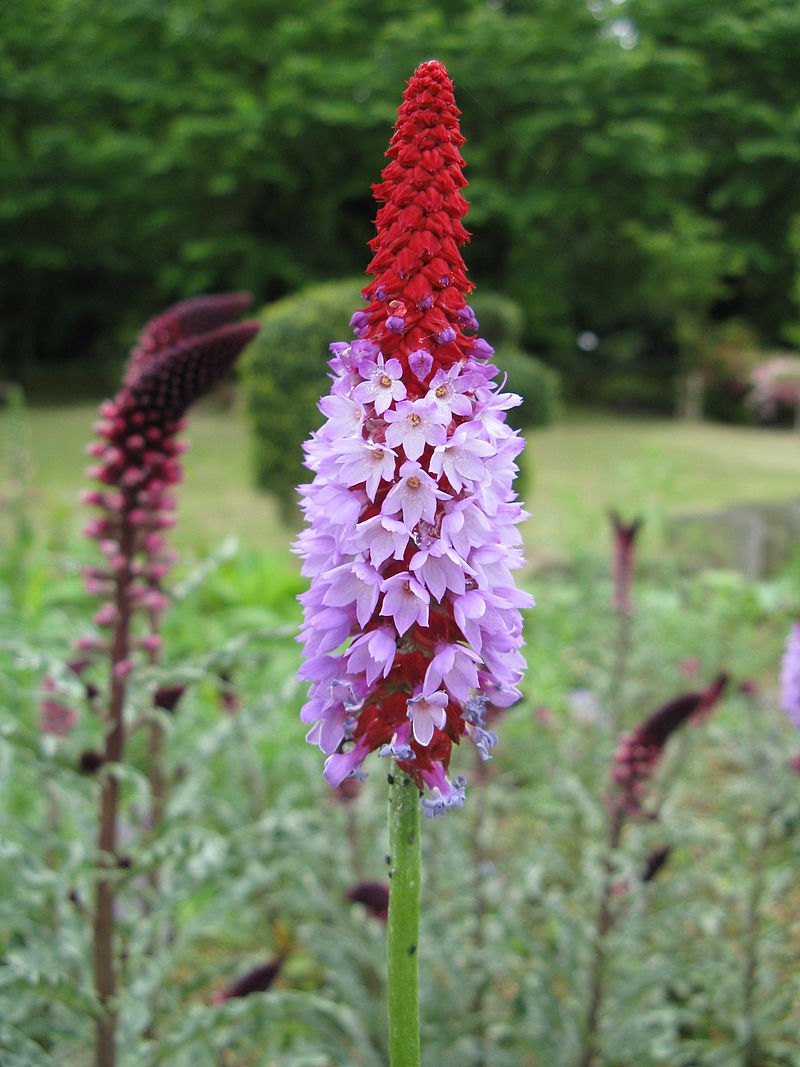
The orchid primula is arguably one of the most delicate and beautiful of all the primula species. Native to the Chinese regions of north-west Yunnan and south-west Szechwan this distinctive species differs from many of it relatives because of its highly ornamental, compound flower spike.

Primula vialii was first brought to the attention of European gardeners after its discovery by the well-known Scottish plant hunter George Forrest (1873-1932). It was originally named Primula littoniana after his friend, Consul G. Litton, however this is now relegated to a synonym. It turns out that Forrest was beaten to the post by another plant hunter, the French missionary botanist Père Delavay who had already named this new discovery Primula vialii.

The Orchid primula - Primula vialii
In its native habitat the orchid primula prefers to grow in wet meadows, near water in valleys and rather strangely in thickets of prickly oak bushes.

The erect, spear-shaped (lanceolate) leaves are produced in tufts and are a light green in colour. They are are soft, hairy and can be as much as 30 cm long on mature plants.

The flowers are produced from June to July and are formed on stout stems up to 60 cm tall. The flower buds and calyces are scarlet while the flowers themselves open up to a lavender-blue colour.

When grown as a garden plant the orchid primula is best grown under light woodland conditions but in a suitably moist, slightly acidic soil. They will they also grow in a more open situation so long as the are not allowed to dry out over the summer. They are often grow as an aquatic marginal plant and while they may tolerate waterlogged conditions they will not thrive.

Primula vialii received the Award of Garden Merit (AGM) from the Royal Horticultural Society in 1993.

Image credits - By I, KENPEI, CC BY-SA 3.0, https://commons.wikimedia.org/w/index.php?curid=4041931

For related articles click onto the following links:
POLYANTHUS 'GOLD LACE'
THE ANGEL ORCHID - Habenaria Grandifloriformis
THE ORCHID PRIMULA - Primula vialii

BULLEY'S PRIMROSE - Primula bulleyana

Bulley's primrose - Primula bulleyana
Bulley's primrose - Primula bulleyana is an absolutely gorgeous species of semi-evergreen perennial from the Primulaceae family. Native to the Yunnan province in China, it was first introduced to European gardeners by George Forrest in 1906. Forrest named this new species of primula after Arthur K Bulley, a cotton broker from Liverpool and a keen amateur gardener who was the first to sponsor Forrest on his many plant hunting expeditions to China. Bulley also founded the Bees Ltd. nursery and was responsible for the introduction of many new hardy plant and alpine species to the UK in the early 20th century.

The natural habitat of Bully's primrose are damp, free-draining hillsides, so it makes sense when planting in a garden environment to plant them in a sunny position although it will tolerate partial shade. Primula bulleyana is best grown in a deep, damp, even boggy soil and will do particularly well beside a pond, but not with the roots completely submerged. It will establishes itself as a strong clump with a couple of years and has proven itself to be very hardy when grown in northern European conditions.

Primula bulleyana will form a basal rosette of simple light-green leaves, 5–14 inches long and 1–4 inches wide and is listed as one of the group known as candelabra primulas. So called because of the tiered arrangement of their flowers. The sturdy, erect flowering stems appear from June to July and can be as much as 24 inches in height. These stems rise in groups bearing 5-7 whorls of orange-yellow flowers 1 inch across which open from red buds. Cut back any spent flower stems.

Primula bulleyana can be propagated by division in early spring, although it will propagate itself by self-sown seedlings so long as the seed lands in damp conditions.

 Primula bulleyana gained the Royal Horticultural Society's Award of Garden Merit in 1993.

Main image credit - By Eric in SF - Own work, CC BY-SA 3.0, https://commons.wikimedia.org/w/index.php?curid=8317802

For related articles click onto the following links:
POLYANTHUS 'GOLD LACE'
THE ORCHID PRIMULA - Primula vialii

POLYANTHUS 'GOLD LACE'

Polyanthus 'Gold Lace'
Polyanthus 'Gold Lace' 
Polyanthus 'Gold Lace' is a gorgeous ornamental perennial which has a history of cultivation dating back to the mid 1600's. English plant breeders took this cultivar to their hearts and after centuries of careful selection they have given us what we have today.

Strangely Polyanthus 'Gold Lace' has had a habit of falling in and out of fashion with growers but was particularly popular with Victorian gardeners. In fact the Victorians held Polyanthum 'Gold Lace' cultivars in such high regard that they used to display them on stages draped with black fabric and place frames around them to view them without distraction!

Polyanthus 'Gold Lace'
Polyanthus 'Gold Lace' 
Unfortunately the years of continuous hybridization in search for perfect blooms has caused Polyanthus 'Gold Lace' to lose its hardy ruggedness. So while there are still easy to grow from seed they tend to be treated as annuals, particularly in colder northern European climates.

The flower of the Polyanthus 'Gold Lace' is similar to that of Primula auricula cultivars in that it is formed by a single petal only. However being divided at the edge, it appears for all intents and purposes to be five or six petals. The flowers will vary in colours from plant to plant from red, through to brown and sometimes so dark they appear almost black! There is a tendency for the darker forms to produce a lacing of silver rather than gold. These are more correctly known as Silver Lace.

Growing to a height and spread of approximately 20 cm Polyanthus primula 'Gold Lace' is noted for its has unusual golden-eyed flowers with rich mahogany-crimson petals and gold laced edges. It has ovate mid-green leaves, which are occasionally seen with a reddish tint.

Polyanthus 'Gold Lace will perform best in a moist, slightly acid soil in partial shade. However they can tolerate a position of full sun if the soil is kept moist.

Be aware that polyanthus leaves are a particular favourite if both slugs and snail and so preventative measures will need to be put in place to maintain top condition.

For related articles click onto the following links:
OLD ENGLISH PLANTS - Polyanthus ‘Gold Lace’
POLYANTHUS 'GOLD LACE'
THE ORCHID PRIMULA - Primula vialii

HOW TO PROPAGATE COWSLIPS AND PRIMROSES

yellow primrose flowers
How to propagate cowslips and primroses

These elegant native wildflowers are slowly disappearing from the English countryside and although it's illegal to collect plant from the wild it is legal to collect their seed for use in propagation. If you have access to plants from cultivated stock them you can also propagate from them by division after they have finished flowering in the autumn.

PROPAGATION BY SEED

Botanical illustration of cowslip and primrose
How to propagate cowslips and primroses
To start with it is important to try and collect your seed as soon as it ripens, this will be sometime around August and September. You can identify good quality seed as it should feel firm, and covered with a slightly slippery film. If you can, sow immediately after collection - that way you can get germination as soon as possible - somewhere between 4 to 6 weeks - otherwise you will need to store it refrigerated in an airtight container and sow in the spring. If you collect the seed later than that then dormancy would have set in and the seed will need a period of cold temperature - stratification - to break the dormancy. The optimum period for stratification is about 4 weeks at a temperature of about 5 degrees Celsius. Any longer and the seed may revert back to dormancy.

Once you have your seed, rather than use a standard seed tray try to use a deeper container, something around 4 inches deep as this will help prevent your compost mix from drying out. This is important as low moisture level can reduce primula seed viability. Take a good seed compost like John Innes seed and potting and mix in a quarter of its volume of vermiculite - although some people advocate a completely soilless seed compost for better results. Fill the container to within an inch of its top then give it a light watering. Next, finely spray the surface with a copper fungicide such as cheshunt compound.

Yellow cowslip flowers
How to propagate cowslips and primroses
Sow the seed thinly and evenly, and leave uncovered. In fact the seeds from most primula varieties should never be covered with any depth of soil as they will need the light as a trigger for germination. Slowly immerse the container till the surface is wet, but do not allow water to seep over the edge of the container. Then, when you lift the container from the water the seed should be sitting tight against the soil. If you are feeling cautious spray the surface again with the copper compound. Now place the whole container inside a clear plastic bag and secure it closed with a loose knot or plastic-covered wire. This will then make additional watering unnecessary until after the seeds have germinated. Although this may well seem to be an odd technique, this is also done to prevent the compost from drying out reducing the failure of germination.

Another technique which can be employed to prevent poor germination is to add a 1/4" layer of wet sphagnum moss on top of the seed compost before sowing. The seeds can be sown directly on to this. Again water the container form the base and not from above, and instead of placing the container into a closed plastic bag try using an empty, same-size seed tray, turned upside down to act as a cover - you may need to weigh it down to prevent it falling off. When the first seeds begin to sprout, water again with Benlate and then apply a very thin layer of seed compost over the seeds. Replace the covering tray until the seedlings come up through the compost. Then remove the cover replacing it with either fine netting, polythene, or a glass cloche for protection.

Once the first set of true leaves have developed the plants can be transplanted out into a good quality, free draining multi-purpose compost - again you may need to add vermiculite as a quarter of your mix. Keep them well-watered and in partial shade till they are ready to plant out into the garden. Keep an eye out for aphids.

Main image credit - By No machine-readable author provided. Pokrajac assumed (based on copyright claims). - No machine-readable source provided. Own work assumed (based on copyright claims)., CC BY-SA 3.0, https://commons.wikimedia.org/w/index.php?curid=1725209

In text image Attribution: Bob Danylec https://creativecommons.org/licenses/by-sa/2.0/deed.en

For related articles click onto the following links:
BBC Primula
HOW TO GROW AURICULAS FROM SEED
HOW TO GROW NATIVE WILD PRIMROSES AND POLYANTHUS FROM SEED
OLD ENGLISH PLANTS - Polyanthus ‘Gold Lace’
PRIMROSE AND COWSLIP PESTS AND DISEASES

HOW TO GROW NATIVE WILD PRIMROSES AND POLYANTHUS FROM SEED


Wild polyanthus growing in a field.
How to grow native wild primroses and polyanthus from seed


These elegant native wildflowers are slowly disappearing from the English countryside and although it's illegal to collect plant from the wild it is legal to collect their seed for use in propagation. If you have access to plants from cultivated stock them you can also propagate from them by division after they have finished flowering in the autumn.

Yellow flowers of wild polyanthus
How to grow native wild primroses and polyanthus from seed
When propagating primroses or polyanthus from seed it's important to try and collect your seed as soon as it ripens, this will be sometime around August and September. You can identify good quality seed as it should feel firm, and covered with a slightly slippery film. If you can, sow immediately after collection - that way you can get germination as soon as possible - somewhere between 4 to 6 weeks - otherwise you will need to store it refrigerated in an airtight container and sow in the spring. If you collect the seed later than that then dormancy would have set in and the seed will need a period of cold temperature - stratification - to break the dormancy.

The optimum period for stratification is about 4 weeks at a temperature of about 5 degrees Celsius. Any longer and the seed may revert back to dormancy. Once you have your seed, rather than use a standard seed tray try to use a deeper container, something around 4 inches deep as this will help prevent your compost mix from drying out. This is important as low moisture level can reduce primula seed viability. Take a good seed compost like John Innes seed and potting and mix in a quarter of its volume of vermiculite - although some people advocate a completely soilless seed compost for better results.

Pot filled with primrose seedlings
How to grow native wild primroses and polyanthus from seed
Fill the tray to within an inch of its top then give it a light watering. Next, finely spray the surface with a copper fungicide such as cheshunt compound. Sow the seed thinly and evenly, and leave uncovered. In fact the seeds from most primula varieties should never be covered with any depth of soil as they will need the light as a trigger for germination. Slowly immerse the container till the surface is wet, but do not allow water to seep over the edge of the container. Then, when you lift the container from the water the seed should be sitting tight against the soil. If you are feeling cautious spray the surface again with the copper compound.

Now place the whole container inside a clear plastic bag and secure it closed with a loose knot or plastic-covered wire. This will then make additional watering unnecessary until after the seeds have germinated. Although this may well seem to be an odd technique, this is also done to prevent the compost from drying out reducing the failure of germination.

Large polyanthus growing in lawn
How to grow native wild primroses and polyanthus from seed
Another technique which can be employed to prevent poor germination is to add a 1/4" layer of wet sphagnum moss on top of the seed compost before sowing. The seeds can be sown directly onto this. Again water the container form the base and not from above, and instead of placing the container into a closed plastic bag try using an empty, same-size seed tray, turned upside down to act as a cover - you may need to weigh it down to prevent it falling off.

When the first seeds begin to sprout, water again with Benlate and then apply a very thin layer of seed compost over the seeds. Replace the covering tray until the seedlings come up through the compost. Then remove the cover replacing it with either fine netting, polythene, or a glass cloche for protection. Once the first set of true leaves have developed the plants can be transplanted out into a good quality, free draining multi-purpose compost - again you may need to add vermiculite as a quarter of your mix . Keep them well-watered and in partial shade till they're ready to plant out into the garden. Keep an eye out for aphids.

For related articles click onto the following links:
HOW TO GROW AURICULAS FROM SEED
HOW TO GROW BELLIS PERENNIS FROM SEED
How to Grow Primroses from Seed
HOW TO GROW THE PYRETHRUM DAISY FROM SEED
HOW TO PROPAGATE COWSLIPS AND PRIMROSES
OLD ENGLISH PLANTS - Polyanthus ‘Gold Lace’
PRIMROSE AND COWSLIP PESTS AND DISEASES

PRIMROSE AND COWSLIP PESTS AND DISEASES

primrose yellow flowers
Primrose and cowslip pests and diseases


Like many soft herbaceous plant, primulas can be effected by a range of pests and disease. It's important to be able to identify them due to the differences in their control. Below is a list of the more common problems you are likely to meet.
.
APHIDS

Cause: Aphids are a well known pest insect that can quickly colonize the soft tissue parts of your plant. They damage and weaken the plant by sucking the sap out of pressurized parenchymal cells just below the leaf cuticle.
Symptoms: Clusters of these small insects are readily identifiable, normally at the plants tips or on the underside of their leaves. In severe cases, the infected parts can begin to wither due to the quantity of sap being removed from that area.
Treatment: There are many chemical treatments available including a number of organic, but all of these must be applied at the first signs of infection to achieve the best effect. For further information click onto:

How to Make a Natural and Organic Insecticide for Aphids
Sacrificial Planting

MOSAIC VIRUS
cowslip yellow flowers
Primrose and cowslip pests and diseases

Cause: Primulas can be cross infected by the cucumber mosaic virus which is transported from plant to plant by aphids.
Symptoms: This can be identified by a mosaic, yellow leaf mottling, often appearing on severely stunted growth. You may also see browning of the veins.
Treatment: Although its not a serious problem in the garden, the plant should still be lifted and destroyed to prevent further spread of the virus.

FOOT ROT, CROWN ROT, ROOT ROT AND BROWN CORE
.
Cause: These rots are caused by a wide range of fungal attacks making exact identification almost impossible. However their action and treatment are all very much the same.
Symptoms: The earliest signs of this fast acting rot are indicated by the production of smaller leaves which turn yellow before wilting. Flowering will be reduced and the plant will be loose in the pot or ground due to its decaying root system.
Treatment: Any infected plants should be removed and destroyed. Sometimes, improvements in drainage, nutrient availability and changes in the soil pH can indirectly improve the situation but there are no effective chemical cures.

GREY MOULD and DOWNY MILDEW

Cause: This group of fungi can affects many plants and unfortunately they are not host specific. This means that they are able to cross infect plants from a variety of different host plant families.
Symptoms: These moulds can easily be identified by a white or grey powdery coating that can appears on the leaves, stems or flowers of your plant. As the infection progresses this coating will spread to envelope the rest of the plant, eventually killing it.
Treatment: There are a number of effective chemical treatments that can be applied here, but infected plants will need fortnightly applications during the Summer - particularly during prolonged dry periods. Sulphur is a popular choice, particularly with organic gardeners although it can damage sensitive plants. A more reliable alternative is to use a general systemic fungicide.

PRIMULA RUST or LEAF SPOT- Puccinia primulae

Cause: More commonly found on Primula vulgaris, rust isn't often seen in the south of the country, but it can be encountered on plants growing in the north of England and further into Scotland.
Symptoms: It can be identified by checking on the underside of the leaves, looking for groups of yellow spots which later turn a dark brown in color.
Treatments: It is a difficult fungus to treat involving rotating applications of different fungicides. Fortunately, the disease isn't particularly invasive and so can be dealt with by either removing the infected leaves or just to leave it as it is.

Main image credit - By No machine-readable author provided. Pokrajac assumed (based on copyright claims). - No machine-readable source provided. Own work assumed (based on copyright claims)., CC BY-SA 3.0, https://commons.wikimedia.org/w/index.php?curid=1725209

In text image Attribution: Bob Danylec https://creativecommons.org/licenses/by-sa/2.0/deed.en

For related articles click onto the following links:
HOW TO GROW AURICULAS FROM SEED
HOW TO GROW NATIVE WILD PRIMROSES AND POLYANTHUS FROM SEED
HOW TO PROPAGATE COWSLIPS AND PRIMROSES
OLD ENGLISH PLANTS - Polyanthus ‘Gold Lace’
TULIP DISEASES

HOW TO ATTRACT THE HUMMINGBIRD HAWK MOTH

hummingbird hawk moth feeding from laveder flowers
How to attract the hummingbird hawk moth

If you have never come across a hummingbird hawk moth before then your first time may come as a bit of a shock, a pleasant one of course. The reason why is this, the hummingbird hawk moth is responsible for the largest number of mistaken identity cases of any animal within the British Isles. Unsurprisingly this would be the actual hummingbird.

Unlike the majority of moths you would come across, this one is already unusual by being active during daylight hours. However it’s most unusual feature – and the reason behind it miss-identification - is the way it flies. It beats its wings so fast that they are no more than a blur, and like a true hummingbird they are able to hover whilst feeding for nectar with a long uncoiled proboscis. To complete the illusion, the speed of their beating wings is such that they emit the trademark hum from which the hummingbird gets its name.
.
Compared to our native moths it’s much more colourful too. Its wings are coloured green or reddish brown, while its dark body is punctuated with dots and stripes of yellow and white

So how it has such an exotic species managed to find its way to our emerald shores. Abundant and resident in all Mediterranean countries, the Hummingbird moth migratory habits are well documented with many thousands moving northwards in Europe during the spring. There is also evidence of a return migration in the autumn. Although they are known to successfully breed in this country, they are generally unable to survive our winters. This means that we are always reliant on new colonies coming up from southern France.

To increase your chances of attracting the hummingbird moth to your garden, there are a number of plants that you can add to your borders that can help to encourage them. Of particular importance is the Galium verum, more commonly known as Lady's Bedstraw or Yellow Bedstraw. This is the plant that the adults prefer to lay their eggs on, although they have also been known to hatch on Centranthus, Stellaria and Epilobium.

The hummingbird hawk moth is also known to have a remarkably good memory with individual moths returning to the same flower beds every day at about the same time. Again, by including in your borders the plants that they are known to be partial too, you can dramatically increase your chances of these moths visiting your area.

Due to their high energy needs they are strongly attracted to flowers with a plentiful supply of nectar. These would include plants such as the single flowered petunias, honeysuckle, buddleia, red valerian, honeysuckle, jasmine, lilac, Escallonia, and phlox. Sedum spectabile is popular but not the fancy varieties as they don't produce enough nectar. Also consider, Nicotiana, native Primula and viola varieties, Syringa, herbaceous and bedding Verbena, Echium, and Stachys. Happy fishing!

Main Image credit - IronChris https://creativecommons.org/licenses/by-sa/3.0/

For related articles click onto the following links:
Butterfly conservation
HOW TO FEED HUMMINGBIRDS
HOW TO GROW VERBENA BONARIENSIS FROM SEED
SEED BEARING PLANTS FOR ATTRACTING WILD FINCHES
HOW TO ATTRACT THE HUMMINGBIRD HAWK MOTH
THE DEAD LEAF BUTTERFLY
THE SWALLOWTAIL BUTTERFLY
VERBENA BONARIENSIS
WHAT DO HUMMINGBIRDS EAT?
WHAT IS THE DIFFERENCE BETWEEN A MOTH AND A BUTTERFLY?
THE WORLD'S LARGEST BUTTERFLY - Ornithoptera alexandrae
WHAT IS THE WORLD'S LARGEST MOTH?

THE HUMMINGBIRD HAWK MOTH


Strange but true, the Hummingbird Hawk Moth is one of nature's most incorrectly identified creatures and why wouldn't it be? Incredible manoeuvrability, able to hover fixed in space, and all the while emitting a bustling, industrious hum, the Hummingbird Hawk moth bears all the trademark of a genuine hummingbird, even down to its bright colouration!

Hummingbird Hawk Moth - Iron Chris
It turns out that these two distinctly different creatures display the rare characteristic of  'Convergent Evolution'. This is when two independent species independently acquire similar characteristics.

Of course, true hummingbirds are native to the southern parts of the United States of America, and while the European Hummingbird hawk moth may originate from the warm climates of Asia, North Africa and the Mediterranean, it will in fact make its way up to cooler European countries as the summer progresses.

This means that with the Atlantic ocean separating the two species, they will never occur on the same continent without the intervention of man. Unfortunately, while they are able to reach our colder, northern European climates they are unable to produce a viable population that will survive the far colder winters.

Unlike the majority of moths, the Hummingbird Hawk Moth is often seen flying during the day, not only in bright sunshine, but also at dusk, dawn, and even in the rain!

Hummingbird Hawk Moth caterpillar - A. M. Liosi
Hummingbird hawk-moths are often seen in gardens, parks, and meadows, bushes, so if you want to try and encourage this fascinating creature into your own garden then you can consider planting its preferred food plants. They are particularly fond of nectar-rich flowering plants such as Centranthus, Buddleia, Nicotiana, Primula, Viola, Syringa, Verbena, Echium, Phlox, and Stachys, and climbing plants such as honeysuckle and jasmine. Once they have found your garden they will tend to stay a while as research has shown that they 'trap-line' which means that habitually return to the same plants at about the same time each day.

It is also worth planting the host plants on which the Hummingbird Hawk Moths lays its eggs and larvae subsequently feed from. These would include Galium species (bedstraws) or Rubia species (madders), but will also lay eggs on Centranthus, Stellaria, and Epilobium.

For related article click onto the following links:
FOOD PLANTS FOR CATERPILLARS
HOW TO ATTRACT THE HUMMINGBIRD HAWK MOTH
HOW TO FEED HUMMINGBIRDS
HOW TO GROW VERBENA BONARIENSIS FROM SEED
The Dead Leaf Butterfly
THE HUMMINGBIRD HAWK MOTH
THE PAINTED LADY BUTTERFLY
THE SWALLOWTAIL BUTTERFLY
THE WORLD'S LARGEST BUTTERFLY - Ornithoptera alexandrae
VERBENA BONARIENSIS
WHAT DO HUMMINGBIRDS EAT?
WHAT IS THE DIFFERENCE BETWEEN A MOTH AND A BUTTERFLY?
WHEN AND HOW TO PRUNE BACK BUDDLEIA
THE WORLD'S LARGEST BUTTERFLY - Ornithoptera alexandrae
WHAT IS THE WORLD'S LARGEST MOTH?

OLD ENGLISH PLANTS - Polyanthus ‘Gold Lace’

Polyanthus 'Gold Lace' flowers
Old English Plants - Polyanthus 'Gold Lace'
Polyanthus ‘Gold Lace’ is one of those varieties that always attract the eye. Its ‘auricular’ style of flower - unusual for polyanthus varieties - is both bold and intricate, but don't let its delicately patterned flower fool you because the 'Gold Laced' Polyanthus is as tough as old boots and extremely winter hardy.

Dating back to the mid-1600’s, Polyanthus ‘Gold Lace’ is a true historical gem; in fact it was once held in such high regard and considered to be the ‘Florists’ polyanthus. Like primula auricular cultivated varieties they were displayed on stages draped with a black fabric and surrounded by a frame in order to view them without distraction.

Mature Polyanthus 'Gold Lace' plants in full flower
Old English Plants - Polyanthus 'Gold Lace'
This was during a time (18th and 19th centuries) when the word ‘florist’ was used to described enthusiasts of a limited range of flowers who, having grown their speciality flower to perfection, showed it in keen competition against those grown by their fellow florists. A passion which is still followed by breeders in the United States today.

It has unfortunately fallen in and out of favour over the centuries since it made its first appearance and, for a time, was at risk of disappearing completely. Today its unusual flowers are back in favour, a breath of fresh air when compared to the blousy hybrids that are more commonly sold.

They can be grown from seed sown during the first half of the year – any time between January and June, but don't expect to see any flowers until the following year. They are just as easy to grow from seed as any of the common garden primroses and polyanthus, its only requirements is that they are raised in a damp, well-drained soil in a sunny to semi-shaded position. That being said they are not quite as hardy, and like auricular are best overwintered in a frost-free position. Generally if they are left to over-winter outside, especially in colder, northern climates they will either succumb to the poor environmental condition or become damaged to a point they are unable to produce a decent specimen the following year. The best practice is to over-winter them in an unheated greenhouse, keeping the compost just on the moist side.

Once new growth appears in the spring, watering can slowly increase as daytime temperatures rise. Apply a liquid soluble fertilizer once a month for plants in the ground and every two weeks for pot grown specimens.

Polyanthus ‘Gold Lace’ it is attractive to both bees and butterflies and therefore more is also environmentally friendly than the modern, and arguably more popular, double-flowered cultivars.

For related articles click onto the following links:
HOW TO GROW AURICULAS FROM SEED
HOW TO GROW NATIVE WILD PRIMROSES AND POLYANTHUS FROM SEED
HOW TO PROPAGATE COWSLIPS AND PRIMROSES
Polyanthus
PRIMROSE AND COWSLIP PESTS AND DISEASES