Gaius Julius Caesar July 100 BC – 15 March 44 BC was a Roman general and statesman and a distinguished writer of Latin prose. He played a critical role in the gradual transformation of the Roman Republic into the Roman Empire. He also greatly extended the Roman empire before seizing power and making himself dictator of Rome, paving the way for the imperial system.
Julius Caesar was born in Rome on 12 or 13 July 100 BC into the prestigious Julian clan. His family were closely connected with the Marian faction in Roman politics. Caesar himself progressed within the Roman political system, becoming in succession quaestor (69 BC), aedile (65 BC) and praetor (62 BC). In 61-60 BC he served as governor of the Roman province of Spain.
Back in Rome in 60 BC, Caesar made a pact with Pompey and Crassus, who helped him to get elected as consul for 59 BC. The following year he was appointed governor of Roman Gaul where he stayed for eight years, adding the whole of modern France and Belgium to the Roman empire, and making Rome safe from the possibility of Gallic invasions. He made two expeditions to Britain, in 55 BC and 54 BC.
Julius Caesar, in his famous account of the Gallic Wars of the 50's BC, provided readers at home with a blood-curdling description of the Germanic tribes he encountered in battle:
'...The various tribes regard it as their greatest glory to lay waste as much as possible of the land around them and to keep it uninhabited. They hold it a proof of a people's valor to drive their neighbors from their homes, so that no-one dare settle near them. No discredit attaches to plundering raids outside tribal frontiers. The Germans say that they serve to keep young men in training and prevent them from getting lazy...'
Caesar then returned to Italy, disregarding the authority of the senate and famously crossing the Rubicon river without disbanding his army. In the ensuing civil war Caesar defeated the republican forces. Pompey fled to the Egyptian capital Alexandria, where he was murdered on the orders of Ptolemy. Caesar followed and he and Cleopatra became lovers. Cleopatra, who had been exiled by her brother, was re-installed as queen with Roman military support. Ptolemy was killed in the fighting and another brother was created Ptolemy XIII. In 47 BC, Cleopatra bore Caesar a child - Caesarion - though Caesar never publicly acknowledged him as his son. Cleopatra followed Caesar back to Rome where he made himself consul and dictator and therefore master of Rome.
He used his power to carry out much-needed reform, relieving debt, enlarging the senate, building the Forum Iulium and revising the calendar. Dictatorship was always regarded a temporary position but in 44 BC, Caesar took it for life. His success and ambition alienated strongly republican senators. A group of these, led by Cassius and Brutus, assassinated Caesar on the Ides of March 44 BC. This sparked the final round of civil wars that ended the Republic and brought about the elevation of Caesar's great nephew and designated heir, Octavian, as Augustus, the first emperor.
For related articles click onto the following links: How to get to Villa Adriana from Rome ROME: The Roman Colosseum ROME: What did the Romans Eat? ROME: What does 'SPQR' mean? WHO WAS GENERAL JAMES WOLFE WHO WAS JULIUS CAESAR?
The giraffe is one of the iconic and spectacular land mammals of the African plains, but how much do we know about them? To find out more, try digesting my overly-long list of giraffe facts:
1. The giraffe is the tallest living terrestrial animal and the world's largest ruminant. Fully grown giraffes stand 5–6 m (16–20 ft) tall, with males taller than females. The average weight is 1,600 kg (3,500 lb) for an adult male and 830 kg (1,800 lb) for an adult female
2. The giraffes specific name - Giraffa camelopardalis refers to its camel-like face and the patches of color on its fur, which bear a vague resemblance to a leopard's spots.
3. The giraffe is noted for its extremely long neck and legs, as well as its horn-like ossicones.
4. The giraffes closest living relative is the okapi.
5. There are nine subspecies of giraffe which are distinguished by their coat patterns.
6. The giraffe's scattered range extends from Chad in the north to South Africa in the south, and from Niger in the west to Somalia in the east. Giraffes usually inhabit savannas, grasslands, and open woodlands.
7. The primary food source for giraffes are acacia leaves, which they can browse at heights that most other herbivores cannot reach.
8. Giraffes are preyed on by lions, and calves are also targeted by leopards, spotted hyenas and wild dogs.
9. Adult giraffes do not have strong social bonds, though they do gather in loose aggregations if they happen to be moving in the same general direction.
10. Males establish social hierarchies through "necking", which are combat bouts where the neck is used as a weapon. Dominant males gain mating access to females, who bear the sole responsibility for raising the young.
11. The giraffe family was once much more extensive, with over 10 fossil genera described. Giraffids first arose 8 million years ago (mya) in south-central Europe during the Miocene epoch.
12. The giraffe was one of the many species first described by Carl Linnaeus in 1758. He gave it the binomial name Cervus camelopardalis. Morten Thrane Brünnich classified the genus Giraffa in 1772.
13. Giraffe subspecies are distinguished by their coat patterns.
14. Despite its long neck and legs, the giraffe's body is relatively short. Located at both sides of the head, the giraffe's large, bulging eyes give it good all-round vision from its great height.
15. Giraffes see in colour and their senses of hearing and smell are also sharp.
16. Giraffes can close its muscular nostrils to protect against sandstorms and ants.
17. The giraffe's prehensile tongue is about 50 cm (20 in) long. It is purplish-black in colour, perhaps to protect against sunburn, and is useful for grasping foliage as well as for grooming and cleaning the animal's nose.
18. The upper lip of the giraffe is also prehensile and useful when foraging. The lips, tongue and inside of the mouth are covered in papillae to protect against thorns.
19. The coat has dark blotches or patches (which can be orange, chestnut, brown or nearly black on colour) separated by light hair (usually white or cream in colour). Each individual giraffe has a unique coat pattern. The coat pattern serves as camouflage, allowing it to blend in the light and shade patterns of savannah woodlands. The skin underneath the dark areas may serve as windows for thermoregulation, being sites for complex blood vessel systems and large sweat glands.
20. The skin of a giraffe is mostly gray. It is also thick and allows them to run through thorn bush without being punctured. Their fur may serve as a chemical defence, as it is full of parasite repellents that give the animal a characteristic scent. There are at least eleven main aromatic chemicals in the fur, although indole and 3-methylindole are responsible for most of the smell. Because the males have a stronger odour than the females, it is suspected that it also has a sexual function.
21. Along the animal's neck is a mane made of short, erect hairs.
22. The giraffes 1 m (3.3 ft) tail ends in a long, dark tuft of hair and is used as a defense against insects.
23. A giraffe's skull is lightened by multiple sinuses. However, as male giraffes age, their skulls become heavier and more club-like, helping them become more dominant in combat.
24. The front legs of a giraffe are slightly longer than its hind legs.
25. A giraffe has only two gaits: walking and galloping. Walking is done by moving the legs on one side of the body at the same time, then doing the same on the other side. When galloping, the hind legs move around the front legs before the latter move forward, and the tail will curl up. The animal relies on the forward and backward motions of its head and neck to maintain balance and the counter momentum while galloping.
26. The giraffe can reach a sprint speed of up to 60 km/h (37 mph), and can sustain 50 km/h (31 mph) for several kilometres.
27. A giraffe rests by lying with its body on top of its folded legs. In order to lie down, the animal kneels on its front legs and then lowers the rest of its body. To get back up, it first gets on its knees and spreads its hind legs to raise its hindquarters. It then straightens its front legs.
28. The giraffe sleeps intermittently around 4.6 hours per day, mostly at night. It usually sleeps lying down, however, standing sleeps have been recorded, particularly in older individuals. Intermittent short "deep sleep" phases while lying are characterized by the giraffe bending its neck backwards and resting its head on the hip or thigh, a position believed to indicate paradoxical sleep.
29. If the giraffe wants to bend down to drink, it either spreads its front legs or bends its knees.
30. Giraffes would probably not be competent swimmers as their long legs would be highly cumbersome in the water, although they could possibly float. When swimming, the thorax would be weighed down by the front legs, making it difficult for the animal to move its neck and legs in harmony or keep its head above the surface.
31. The circulatory system of the giraffe has several adaptations for its great height. Its heart, which can weigh more than 25 lb (11 kg) and measures about 2 ft (61 cm) long, must generate approximately double the blood pressure required for a human to maintain blood flow to the brain.
32. Giraffes have usually high heart rates for their size, at 150 beats per minute.
33. Female giraffes give birth standing up. Their young endure a rather rude welcome into the world by falling more than 5 feet (1.5 meters) to the ground at birth. These infants can stand in half an hour and run with their mothers an incredible ten hours after birth.
Not only are giraffes the tallest land animal on earth, they also possess the longest neck of any living creature. So long is the giraffe's neck that if it want to take a drink it can't simply lower its head, it has to give itself a fighting chance by either spreading its front legs, bend its knees, or kneel on the ground - a risky move by a water hole no matter how big you are!
There are two main hypotheses regarding the evolutionary origin and maintenance of elongation in giraffe necks. The 'competing browsers hypothesis' was originally suggested by Charles Darwin and only challenged recently.
It suggests that competitive pressure from smaller browsers, such as kudu, steenbok and impala, encouraged the elongation of the neck, as it enabled giraffes to reach food that competitors could not.
This advantage is real, as giraffes can and do feed up to 4.5 m (15 ft) high, while even quite large competitors, such as kudu, can only feed up to about 2 m (6 ft 7 in) high.
There is also research suggesting that browsing competition is intense at lower levels, and giraffes feed more efficiently (gaining more leaf biomass with each mouthful) high in the canopy.
However, scientists disagree about just how much time giraffes spend feeding at levels beyond the reach of other browsers.
The other main theory, the sexual selection hypothesis, proposes that the long necks evolved as a secondary sexual characteristic, giving males an advantage in "necking" contests - see above film clip - to establish dominance and obtain access to sexually receptive females.
In support of this theory, necks are longer and heavier for males than females of the same age, and the former do not employ other forms of combat.
However, one objection is that it fails to explain why female giraffes also have long necks. However, this ridiculous objection is as intelligent as questioning the need for the male nipple. If human males did not have the genetic information for nipples then Mendelian theory would dictate that you would have a selection of human offspring displaying one nipple, two nipples, or no nipples at all!
Therefore, if female giraffes had short necks then you would end up with progeny with a selection of neck sizes. This is isn't going to be very helpful when it come to impressing your future giraffe 'wife' in the next neck bashing competition!
The circulatory system of the giraffe has several adaptations for its great height. Its heart, which can weigh more than 25 lb (11 kg) and measures about 2 ft (61 cm) long, must generate approximately double the blood pressure required for a human to maintain blood flow to the brain.
In order to cope with pumping blood up to such a great height, giraffes have usually high heart rates for their size, at 150 beats per minute.
Giraffes have esophageal muscles that are unusually strong to allow regurgitation of food from the stomach up the neck and into the mouth for rumination.
The incredible, yet stunning looking sago palm is so unusual in shape and design that it almost looks unreal. Both visually and literally prehistoric, species of sago palm can be found across much of the subtropical and tropical regions of the world. However, should you require one for the garden they can be expensive, so growing sago palm seed can be a far more sensible option.
Before you plant up your sago palm seeds, place them into a bucket of water. Mature seeds, which have a bright orange or red color, will sink, while immature or infertile seeds will continue to float. Dispose of any seeds that float as these are unlikely to germinate.
Sago palm seeds
To help encourage successful germination, scrape the outer coating of the seeds with a sharp knife. The seed coat of the sago palm is very hard so scraping it - which is known as scarification - slightly weakens this outer coating, enabling moisture to penetrate into the seed. Wear your garden gloves when performing this activity, as the seed coat is poisonous.
Sow sago palm seeds in large modular trays, or pots, using a good seed compost such as John Innes seed and potting with the seed half out of the compost. Place your newly planted sago palm seeds into a heated propagator an optimum temperature of 70-75F (20-25C), or failing that a warm windowsill out of direct light.
Germination can take 1-3 months, so try to keep the compost moist but not over wet. They are very slow growing at first, and the last thing you want to do is over-water. When you sago palm seedlings are large enough, pot on as required into 5in and finally 8in pots.
Remember that sago palms are not fully hardy and while they are small provide a temperature of 5-10C (40F-50F) throughout the winter. Do not allow them to suffer cold damage as they are unlikely to survive.
Planting sago palm seeds outside
Of course, sago palms are not terribly hardy, even in the southernmost parts of the United Kingdom. However, they can be successfully grown outdoors in both Georgia and Florida.
Select a warm location that does not receive any direct sunlight.
Sago palm seedlings
To begin with, dig a series of shallow furrows into the soil. The furrows should be about 1 inch deep and 18 inches apart.
Place the individual seeds in the furrow. The pointed ends of the seeds should be oriented horizontally.
Space the seeds 12 to 24 inches apart,you will find that this spacing will make it easier to transplant the seedlings later on.
Lightly cover the seeds with soil or sand.
It is not necessary to tamp the soil into place.
Water the area thoroughly, but do not saturate the soil.
Mature sago palms
Continue watering the seed bed on a regular basis, never allowing the soil to dry out completely.
If your seeds are viable they will begin to emerge in three to six months.
Continue to water the the seedlings for another one to two years.
The sago palm is a slow-growing plant and it may take that long before the seedlings develop a root system large enough and strong enough to allow successful transplantation. Once established you should have a stunning specimen which can only improve as time goes on.
If you are unfortunate enough to have not been born in the green and pleasant land that is known to all as England, then your first thoughts of Her Royal Highness's' kingdom are likely to be drawn to the City of London. More specifically St Paul Cathedral, Big Ben, and Buckingham Palace!
Originally known as Buckingham House, the building which forms the core of today's palace was in the beginning just a large townhouse built for the Duke of Buckingham (hence the name) in 1705. However, continuing building work has made the original house unrecognizable. The last major structural additions were made in the late 19th and early 20th centuries, including the East front which contains the well-known balcony on which the Royal Family traditionally congregate to greet crowds outside.
Located in the City of Westminster, Buckingham Palace finally became the official royal palace of the British monarch on the accession of Queen Victoria in 1837.
Today it is best known as the official London residence and office of the British monarch - currently Queen Elizabeth II.
At the rear of the palace, is the large and park-like garden which, together with its lake, is the largest private garden in London.
Here the Queen hosts her annual summer garden parties, and also holds large functions to celebrate royal milestones, such as jubilees. The grounds cover 40 acres, and include a lake, a tennis court, and a helicopter landing pad!
The State Rooms
The principal rooms of the palace are contained on the piano nobile behind the west-facing garden façade at the rear of the palace.
The centre of this ornate suite of state rooms is the Music Room, its large bow the dominant feature of the facade.
Flanking the Music Room are the Blue and the White Drawing rooms.
At the centre of the suite, serving as a corridor to link the state rooms, is the Picture Gallery, which is top-lit and 55 yards (50 m) long.
The Gallery is hung with numerous works including some by Rembrandt, van Dyck, Rubens and Vermeer; other rooms leading from the Picture Gallery are the Throne Room and the Green Drawing Room.
The Green Drawing room serves as a huge anteroom to the Throne Room, and is part of the ceremonial route to the throne from the Guard Room at the top of the Grand staircase.
Most of us are familiar with the magnificent zebra, however there are actually three species of zebras alive today - the plains zebra, the Grévy's zebra and the mountain zebra. The plains zebra and the mountain zebra belong to the subgenus Hippotigris, but Grevy's zebra is the sole species of subgenus Dolichopus.
It is the unique stripes of zebras make these animals among the most familiar to people. They occur in a variety of habitats, such as grasslands, Savannas, woodlands, thorny scrublands, mountains, and coastal hills. However, various factors have had a severe impact on zebra populations, in particular hunting for skins and habitat destruction. The Grevy's zebra and the mountain zebra are endangered, but the plains zebras are much more plentiful.
One subspecies, the quagga, went extinct in the late 19th century, though they have now been re-bred from zebra DNA.
What do Zebras eat?
Food and foraging
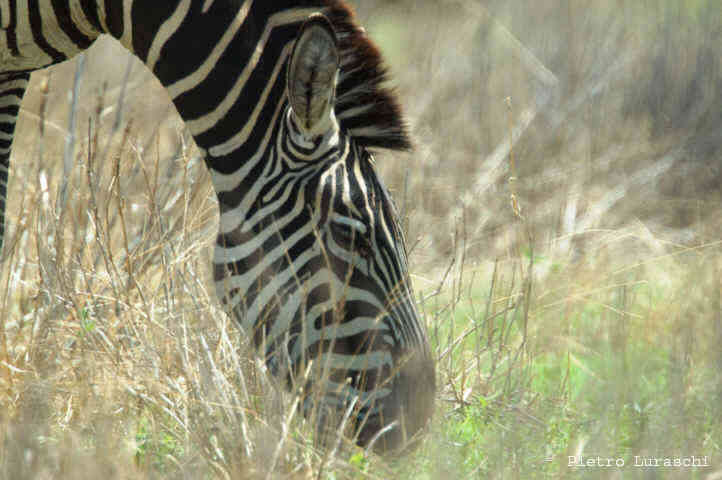
Zebras feed almost entirely on grasses, but may occasionally eat shrubs, herbs, twigs, leaves and bark.
Their digestive systems allow them to subsist on diets of lower nutritional quality than that necessary for other herbivores.
Typically, zebras seek green pastures. During the dry months of the year, they thrive on dry grass, but Zebras tend to remain in the proximity of water holes.
Zebras have a large appetite so they spend almost 60% of the time of their day eating. In zoos, they are fed hay, oats and alfalfa.
Breeding
Female zebras mature earlier than the males, and a mare may have her first foal by the age of three. Males are not able to breed until the age of five or six. Mares may give birth to one foal every twelve months. She nurses the foal for up to a year. Like horses, zebras are able to stand, walk and suckle shortly after they are born.
A zebra foal is brown and white instead of black and white at birth.
Plains and mountain zebra foals are protected by their mothers, as well as the head stallion and the other mares in their group. Grevy's zebra foals have only their mother as a regular protector, since, as Grevy's zebra groups often disband after a few months.
Where do Zebras live?
Grevy’s zebras are essentially confined to the semi-desert of northern Kenya east of the Great Rift Valley and north of the Tana River. Their range extends into neighbouring parts of Ethiopia and Somalia. During the rainy season mature stallions establish territories onto which mares come to foal and probably to breed.
Gestation is thirteen months, longer than any other equid. Once the foals are born, the mares stay within two kilometres (1.2 mi.) of water and are almost always with the territorial stallion. Foals do not drink water until they are three months olds and — unlike any other equid — are left in “kindergartens” frequently guarded by the territorial male while their mothers go to water.
The plains zebra is the most abundant and widespread of wild zebras that still exist today. They occur throughout the tropical grasslands of East and southern Africa. Zebras - for the most part - replace one another geographically. However, there is a zone of overlap between the Grevy’s zebra and the plains zebra on the floodplain of the Ewaso Nyiro in northern Kenya. Here the two species form mixed grazing herds, but there is no record of interbreeding.
The Chapman’s zebra or the Damara zebra (Equus burchelli antiquorum) is a subspecies of plains zebra occurring from Angola and Namibia across northern South Africa to Transvaal. It is characterized by a pattern of broad, dark stripes alternating with thin, light shadow-stripes. The stripes fade into the brownish color of the body on the hindquarters and are absent altogether on the legs.
Another southern subspecies of the plains zebra, the Burchell’s zebra (Equus burchelli burchelli), now extinct, lacked stripes on the hindquarters.
Its basic body color was reddish-yellow. Burchell’s zebra existed from southern Botswana into the Orange Free State of South Africa.
As European settlement spread northward from the Cape to colonial Southern Rhodesia, this subspecies was hunted to extinction. The wild herds had disappeared by 1910, and the last known individual died in the Berlin Zoo in 1918.
The southernmost subspecies, the quagga (Equus burchelli quagga) of South Africa, is also extinct. It occurred in large numbers south of the Orange River at the beginning of the nineteenth century, but Boer settlers destroyed the population for meat and hides.
The quagga disappeared from the wild by 1878, and the last zoo specimen died in 1883. All that remains today are nineteen pelts, a few skulls, three photographs and a few paintings.
The quagga was yellowish-brown with stripes that were confined to the head, neck and forebody. DNA from one of the pelts has been retrieved and analysed, establishing that the quagga was, indeed, a variant of the plains zebra and not a separate species as previously believed. There is currently an experimental breeding program in progress in South Africa to try to reconstruct the quagga from the Chapman’s subspecies.
The third zebra species is the mountain zebra. The most identifying feature of both mountain zebra subspecies is a square flap of skin or dewlap on the throat, best developed on males.
Mountain zebras never form the large herds characteristic of plains zebras, but do exhibit a harem-type social system. During the winter they move up to twenty kilometres (12 mi.) from a water source. Where they are hunted, they take their water at night. Where they are unmolested, they water at any time.
Two subspecies of mountain zebra are recognized - the Hartmann’s zebra and the Cape mountain zebra. The Hartmann’s zebra (Equus zebra hartmanni) occupies the rugged, broken terrain at the edge of the African Plateau east of the Namib Desert. Its habitat grades from an open woodland with a diverse, grassy under-story in southern Angola and Namibia to the succulent steppe of the Karroo in South Africa.
In the 1950's, mountain zebras numbered between 50,000 and 75,000 and were regarded as vermin by an expanding livestock industry. Especially in drought years, zebras competed with cattle for forage and water, and stampeding zebras occasionally tore down fences. By 1960 only 10,000 were left; and in 1973 Hartmann’s zebra was considered an endangered species, with approximately 7,000 head remaining.
Hartmann’s zebras have broad black stripes on an off-white body. The stripes extend down the legs to narrow hooves, but do not meet on the belly. These animals stand from 118 to 132 centimetres (46-52 in.) high. This subspecies seeks shade and rests during the hottest parts of the day and has been demonstrated to orient its body with respect to the sun. The vocalizations of the Hartmann’s zebra are similar to the neigh of a horse.
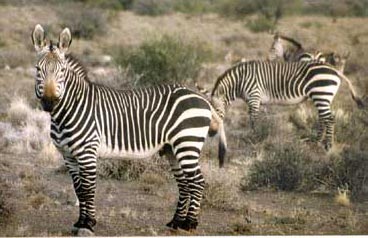
The Cape mountain zebra (Equus zebra zebra) is the smallest of the extant zebras — with a shoulder height of about 120 centimetres (47 in.) — and the most restricted geographically. Its broad black stripes are closely spaced on a pure white body. Overall it is stockier than the Hartmann’s zebra, has longer ears, and has a larger dewlap.
The Cape mountain zebra once inhabited all the mountain ranges of the southern Cape Province of South Africa, but by 1922, only 400 were believed to survive. To counteract the continued decline, Mountain Zebra National Park was established in 1937 on acacia veld near Cradock, South Africa, but its small population of Cape mountain zebra became extinct in 1950. That same year reintroductions from nearby remnant populations began. Eleven animals were donated from a nearby farm in 1950, and in 1964 another small herd was added. By the late 1960's, the total Cape mountain population was only 140 but grew to 200 by 1979, with 75 percent of the animals in Mountain Zebra National Park. In 1984, the population was back to 400 head. Since then a few zebras have been reintroduced to the Cape Point Nature Reserve.
Plants from the Agave family hold some of the most impressive succulents on the planet, and luckily for us, most agaves are relatively easy to grow.
Indigenous to Mexico, agaves are also native to the southern and western United States and central and tropical South America. They are succulents with a large rosette of thick, fleshy leaves, each ending generally in a sharp point and with a spiny margin; the stout stem is usually short, the leaves apparently springing from the root.
Spanish and Portuguese explorers probably brought agave plants back to Europe around the middle of the 16th century, but the plants didn't became popular in Europe until the 19th century when more unusual varieties began to be imported by collectors. Some have been continuously propagated by offset since then, and do not consistently resemble any species known in the wild, although this may simply be due to the differences in growing conditions in Europe.
One of the most familiar species is Agave americana, a native of tropical America. Common names include century plant, maguey (in Mexico), or American aloe (it is not, however, closely related to the genus Aloe). The name "century plant" refers to the long time the plant takes to flower. The number of years before flowering occurs depends on the vigour of the individual plant, the richness of the soil, and the climate; during these years the plant is storing in its fleshy leaves the nourishment required for the effort of flowering.
Agave americana is now widely cultivated as an ornamental. In its variegated forms, the leaf has a white or yellow marginal or central stripe. As the leaves unfold from the centre of the rosette, the impression of the marginal spines is conspicuous on the still erect younger leaves. The plants require protection from frost.
They mature very slowly and die after flowering, but are easily propagated by the offsets from the base of the stem.
Blue A. americana occurs in abundance in the Karoo, and arid highland regions of South Africa. Introduced by the British settlers in 1820, the plant was originally cultivated and used as emergency feed for livestock. Today it is used mainly for the production of syrup and sugar.
How to propagate Agave
Because agaves are relatively slow growing they can be expensive to purchase, so propagating your own agaves is a fantastic way of building up your stocks as well as getting the varieties that you want.
Luckily, the majority of agave species and cultivars will reproduce quite readily from suckers appearing from the base of the parent plant, and some even produce bulbils on the inflorescence (flowering stems). The seeds actually germinate and grow while still attached to the flower stalk!
Another, but rather more drastic way of getting agaves to reproduce, is to remove the centre of the adult plants. Just as with cacti, this stimulates the plant to produce multiple heads, each of which can then be rooted.
Unfortunately, all of these methods of reproduction have disadvantages. For example, not all plants produce clones - some of the most beautiful such as A. Victoriae-reginae and A. ocahui rarely ever do, and even for those that will, the offsets may be poorly shaped or attached too tightly to allow separation from the parent without injury. Furthermore, the offset may contain diseases passed on from the parent. Reproduction by means of bulbils gives you many plants in a hurry, but this tends to be a rare event and characteristic of just certain species.
Perhaps the best way to reproduce agaves is to grow them from seed. Agave seeds are flat - usually - and black in colour. They can also vary considerably in size, usually reflecting the size of the mature plant. As with most plants, the fresher the seeds, the greater the percentage of germination.
Stonehenge is a prehistoric monument located in the English county of Wiltshire, about 2.0 miles (3.2 km) west of Amesbury and 8 miles (13 km) north of Salisbury.
If you are going there by car and using satellite navigation the Postcode for Stonehenge is: SP4 7DE.
By road
From Amesbury
2 miles west on the junction of A303 and A344/360
From London Gatwick Airport
Take the M23 motorway and join the M25 motorway, following the signs for Heathrow Airport.
From the M25, exit at junction 12 for the M3 motorway towards Basingstoke.
Once on the M3 follow it to junction 8 signed A303 Andover.
Continue on the A303 all the way until you reach a roundabout.
Go straight over this and 2 miles on bear right onto the A344 and the car park is on the right hand side about 500 metres on.
From London Heathrow Airport
Follow signs to the M4 West.
Continue for about 2 miles and come off at junction 4b onto the M25 Southbound.
Follow the signs for Gatwick Airport. From the M25, exit at junction 12 for the M3 motorway towards Basingstoke.
Then follow the directions as above.
By train
The nearest train station to Stonehenge is Salisbury about 9.5 miles away.
From London the trains depart from Waterloo Station to Salisbury.
Check for times and prices as these may be subject to change and the trains depart approximately every hour. The journey takes about an hour and a half. Local buses or a cab can take you on.
The buses depart from Heathrow Airport and from Victoria Coach Station in the centre of London. The journey takes about 2 hours.
Get off at Amesbury.
From there you can either walk (about 2 miles) or get a taxi.
You can buy tickets on the coach, at the coach station, or from ticket agents for National Express. It is the cheapest way to travel to Stonehenge.
If you are coming from Gatwick Airport you will need to first get to Heathrow Airport or to Victoria coach station (you can do this by bus) and from there change buses to Salisbury.
Put simply, Whales are large, intelligent, warm blooded, aquatic mammals. They breathe air through a blowhole and into their lungs - unlike fish who breathe using gills. Whales have sleek, streamlined bodies that move easily through the water. They are the only mammals, other than the manatee (sea cows), that live their entire lives in the water, and the only mammals that have adapted to life in the open oceans. Whales also give birth to live young.
The word 'Whale' is the common name for various marine mammals of the order Cetacea. The term whale sometimes refers to all cetaceans, but more often than not it excludes dolphins and porpoises, which belong to suborder Odontoceti (toothed whales). This suborder also includes the sperm whale, killer whale, pilot whale, and beluga whale.
The other Cetacean suborder Mysticeti (baleen whales) are filter feeders that eat small organisms caught by straining seawater through a comblike structure found in the mouth called baleen. This suborder includes the blue whale, the humpback whale, the bowhead whale and the minke whale. All Cetacea have forelimbs modified as fins, a tail with horizontal flukes, and nasal openings (blowholes) on top of the head.
Whales range in size from the blue whale, the largest animal known to have ever existed at 30 m (98 ft) and 180 tonnes (180 long tons; 200 short tons), to various pygmy species, such as the pygmy sperm whale at 3.5 m (11 ft).
Whales collectively inhabit all the world's oceans and number in the millions, with annual population growth rate estimates for various species ranging from 3% to 13%.
For centuries, whales have been hunted for meat and as a source of raw materials. By the middle of the 20th century, however, industrial whaling had left many species seriously endangered, leading to the end of whaling in all but a few countries.
Whales are also extremely intelligent. In fact, it has been estimated that the average Beluga whale has an IQ of 155! To give to a comparative idea in human terms, that would equate to a genius.
It is estimated that the great artist and visionary inventor DaVinci had an IQ of 158. Cetacean intelligence is usually gauged by allometric analysis of brain size compared to body weight.
Whale facts
1. Sperm Whales have the largest brain mass of any living animal, weighing in at 7.8 kg where as a male adult human brain weighs, at the most 1.4 kg.
2. The whales form of song is also the most complex even more so than birds.
3.In order to make sure that whales perform the basic functions to breathe, only
one half of their brain will sleep at a time. This is the only way that they are
able to get the amount of rest that they need and still take care of this
function that is necessary for their bodies to survive.
4. Unlike us, whales are only able to sleep for short periods of time because they have to remember to go to the surface for air as needed.
5. Even though they spend their entire lives underwater, whales cannot breathe under water. Like us, whales breathe by taking in air from the atmosphere through their blowhole.
6. Whales can swim at a rate of about 30 miles per hour. However, they appear much slower because they they spend most of their time gliding around in the water.
7. You would think that whales would have entirely smooth bodies but they don't. They do have hair but it is very
thin and very light so unless you are seeing one up close you wouldn't see any at all.
8. Whales are warm blooded mammals so they have to keep a high body temperature.
Since they don’t have much hair they rely on layers of fat called blubber. You
will find that the younger whales have more hair than the adults. As a baby gets
older it will develop more blubber and then the hair will start to disappear.
9. Whales can grow extremely large. In fact, the Blue Whale is the biggest creature that has ever lived, reaching a length of up to 94 ft! The smallest whale is
the Dwarf Sperm Whale. It is only about 8 feet long.
The giant panda is the rarest member of the bear family and among the world’s most threatened animals. However due to its appealing nature and appearance it has become universally loved and as such attracts enormous effort and financial support to help protect it. Be that as it may, the giant panda's future still remains uncertain.
As China's economy continues to develop rapidly, the giant panda faces a number of clear threats.
Its forest habitat is increasingly fragmented by roads and railway lines, habitat loss continues to occur outside of protected areas, and poaching remains an ever-present threat.
As we learn more about the giant panda, the chances of saving it for future generations can only improve so the more facts that can be uncovered about this amazing creature the better.
Panda Facts
1. The panda, or more accurately known as the Giant Panda is a true bear native to central-western and south western China. It is not related to the red panda!
2. The panda is easily recognizable by its large, distinctive black patches around the eyes, over the ears, and across its round body.
3. The western world first learned of the giant panda in 1869 when the French missionary Armand David received a skin from a hunter on 11 March 1869.
4. The first living giant panda to be seen outside China was by the German zoologist Hugo Weigold, who purchased a cub in 1916.
5. As the emblem of the WWF (World Wide Fund for Nature) and more recently the main character in the hit Kung Fu Panda films, the Giant Panda is among the world's most adored and protected rare animals, and is one of the few in the world whose natural inhabitant status was able to gain a UNESCO World Heritage Site designation.
6. The giant panda is an endangered species because it is threatened by continued habitat loss and by a very low birth rate, both in the wild and in captivity.
7. The giant panda has been a target for poaching by locals since ancient times and then by foreigners since it was introduced to the West. Thankfully, starting in the 1930s, foreigners were unable to poach giant pandas in China because of the Second Sino-Japanese War and the Chinese Civil War, but pandas still remained a source of soft furs for the locals. The population boom in China after 1949 created further stress on the panda's' habitat, and the subsequent famines led to the increased hunting of wildlife, including the Giant Pandas.
8. During the Cultural Revolution, all studies and conservation activities on the pandas were stopped. Then after the Chinese economic reform, demand for panda skins from Hong Kong and Japan led to illegal poaching for the black market -acts which were generally ignored by the local officials at the time.
9. The Wolong National Nature Reserve was set up by the PRC government in 1958 to save the declining panda population, but few advances in the conservation of pandas were made, due to inexperience and insufficient knowledge of Giant Panda ecology. Many believed that the best way to save the pandas was to cage them. As a result, pandas were caged at any sign of decline, and suffered further from the terrible conditions.
10. Because of pollution and destruction of their natural habitat, along with segregation due to caging, reproduction of wild pandas was severely limited. But things began to change in the 1990s, when several laws (including gun control and the removal of resident humans from the reserves) helped the chances of survival for pandas. With these renewed efforts and improved conservation methods, wild pandas have started to increase in numbers in some areas, even though they still are classified as a rare species.
11. In 2006, scientists reported that the number of pandas living in the wild may have been underestimated at about 1,000. Previous population surveys had used conventional methods to estimate the size of the wild panda population, but using a new method that analysers DNA from panda droppings, scientists believe that the wild panda population may be as large as 3,000. Although the species is still endangered, it is thought that the conservation efforts are working. In 2006, there were 40 panda reserves in China, compared to just 13 reserves two decades ago.
12. Despite its taxonomic classification as a carnivore, the giant panda's diet is primarily herbivorous, consisting almost exclusively of bamboo. However, the giant panda still has the digestive system of a carnivore, as well as carnivore-specific genes, and thus derives little energy and little protein from consumption of bamboo. Its ability to digest cellulose is due to the presence of specialised microbes in its gut. The giant panda is therefore a highly specialized animal with unique adaptations having evolved to live in bamboo forests for millions of years.
13.The average giant panda eats as much as 9 to 14 kg (20 to 30 pounds) of bamboo shoots a day. Because the giant panda consumes a diet low in nutrition, it is important for it to keep its digestive tract full. The limited energy input imposed on it by its diet has affected the panda's behaviour. The giant panda tends to limit its social interactions and avoids steeply sloping terrain in order to limit its energy expenditures.
14. Pandas eat any of twenty-five bamboo species in the wild, such as Fargesia dracocephala and Fargesia rufa. Only a few bamboo species are widespread at the high altitudes pandas now inhabit. Bamboo leaves contain the highest protein levels; stems have less. Given this large diet, the giant panda can defecate up to 40 times a day!
15. Because of the synchronous flowering, death, and regeneration of all bamboo within a single species, the giant panda must have at least two different species available in its range to avoid starvation. While primarily herbivorous, the giant panda still retains decidedly carnivorous teeth, enabling the panda to eat meat, fish, and eggs when available. In captivity, zoos typically maintain the giant panda's bamboo diet, though some will provide specially-formulated biscuits or other dietary supplements.
Potatoes are without doubt one of the simplest crops to grow. The trouble is that there are so many different varieties to choose from and every year the risk of damage from potato blight seems to increase. However, get it right and you will have an excellent and flavoursome crop that has required minimum effort to bring to fruition. You can just did a small trench and plant them straight off but 'chitting' your potatoes you can encourage a larger and earlier crop. But what is chitting?
How to Chit or Sprout Potatoes
While soil temperatures remain below about 10 degrees Celsius not much will happen as the potato - a modified storage organ - will be in a state of natural dormancy. Left to their own devices, by the time the soil has warmed up sufficiently to break the dormancy period and begin the new season growth the majority of potato plants won't be ready to crop until the late summer or even autumn. The reality of this growth cycle means that we need to 'force' the seed potatoes into growth artificially by introducing light and heat - normally provided by a well lit room. This stimulates the production of new shoots and kick starts the potato out of it normal dormancy and reduce the time until cropping from anywhere between 1 and 2 months. This is what is known as 'chitting' or sprouting.
You can buy seed potatoes from as early as January but it is probably better to wait until the beginning or middle of February before you begin chitting. Put the seed potatoes into a box where they can be supported in an upright position - cardboard egg boxes are ideal for this – and place them indoors into a light and airy position. During this time they will require a cool temperature of a little over 10 degrees Celsius. Position them so that the end which has the most eyes (dormant sprouts) are uppermost and the 'stalk' end where they were severed from the parent plant is at the bottom. The new sprouts will form in a couple of weeks and as mentioned before its good practice to remove the weaker sprouts leaving four of the strongest to continue. As a general rule of thumb it will normally take about six weeks to chit a batch of potatoes.
Planting Potatoes Potatoes grow best in rich soil containing plenty of well rotted manure or compost. Do not use fresh compost as this will encourage slug damage problems and do not lime the soil as this can cause scab blemishes on developing tubers.
Planting times are not critical but will be dependant on weather, soil conditions and regional variations but below is a general guide.
PLANTING GUIDE
First Earlies: Area Coverage: 20 tubers will plant 20ft (6m)
Planting distance in row: 12 inches (30cm) apart
Distance between rows: 24 inches (60cm)
Plant: from end February
Harvest from: 10 weeks from planting
Second Earlies: Area Coverage: 20 tubers will plant 25ft (7.4m)
Planting distance in row: 15 inches (37 cm) apart
Distance between rows: 30 inches (75cm)
Plant: from mid March
Harvest from: 13 weeks from planting
Early Maincrop: Area Coverage: 20 tubers will plant 30ft (9m)
Planting distance in row: 18 inches (45cm) apart
Distance between rows: 30 inches (75cm)
Plant: from late March
Harvest from: 15 weeks from planting
Late Maincrop: Area Coverage: 20 tubers will plant 30ft (9m)
Planting distance in row: 18 inches (45cm) apart
Distance between rows: 30 inches (75cm)
Plant: from late March
Harvest from: 20 weeks from planting
Potato Fertilizer
Consider using an application of pelleted, high potash fertiliser before planting your seed potatoes. A 3kg bag should be sufficient to plant 60 tubers, using 50g (just under 2 oz) per tuber. Its application is a matter of personal choice, and to a certain extent will depend on the condition of your soil. You can incorporate 50g in each individual planting hole (as with any fertiliser it should not be in immediate contact with the tuber to avoid scorching), or you can incorporate 25g when planting and another 25g when first earthing up. If you plant in a trench instead of using a dibber or a trowel, then you can scatter the pellets along the trench or leave until you earth up.
Potatoes will grow best in slightly acidic soils which can be seasonally created by applying sulphur to the top of the potato ridge after planting. Applying sulphur maximizes the yield and deters skin blemishes like Common Scab.
After care
Most importantly protect emerging shoots from any frosts by carefully drawing soil over the shoots. Frost will blacken the shoots and delay the production of mature tubers. First and Second Earlies will require plenty of water during prolonged dry weather especially when the tubers are starting to form. Earth up regularly as the plants develop.
Start to harvest First Earlies as 'new potatoes' when the plants come into flower, although not all varieties freely flower or flower over an extended period. Therefore, a more reliable method is the number of weeks from date of planting. As a guideline, allow 10 weeks from planting for First Earlies, 13 weeks for Second Earlies, 15 weeks for Early Main crops 20 weeks for Late Main crops. Lifting times will also depend on the growing season, weather conditions at harvest time and the size of tuber you want. Tubers will generally become larger the longer their growing period. Maincrop varieties are usually left for at least two weeks after the leaves and haulms (stems) have withered, to allow the skins to set.
Second Cropping Potatoes
Given the UK climate, I would recommend planting 2nd Cropping Potatoes in the first week of August. The absolute latest that you should be planting these seed potatoes is by the end of August. If planting in a protected environment (e.g. in a polytunnel or greenhouse) planting can be delayed by a week or so at the most but tubers must be planted by the end of the first week of September. Planting any later than this is likely to produce disappointing results. If planting is to be delayed from receipt of the tubers, ensure the tubers are stored in the refrigerator at no lower than 4°C until planting. There is no need to pre-chit the potatoes - this will happen quite naturally after planting. 'Ping-pong ball' sized tubers should be ready for harvesting approximately 10 to 11 weeks after planting. Tubers can be harvested as required, with the others being left in the ground. Cut down the haulms (stems) with secateurs to just above soil level as the leaves wither/yellow or if they show signs of blight and protect from frost. We suggest covering with a thick layer of straw and/or sacking. These can then be lifted at Christmas time. The only potential problem with leaving them in the ground for this length of time is that they will be more susceptible to blight and pest attack (e.g. slugs, wireworm) - the longer they are in the ground, the more possibility there is of being exposed to these pests and diseases.