The chimpanzee’s diet consists mainly of fruits of all kinds. After an early morning feed, chimpanzees tend to spend the rest of the early part of the day relaxing. But they will continue to ‘graze’ by picking occasionally at any edible leaves, buds, berries or blossoms that they come across.
They tend to have a second – more intensive – feeding period later on in the day, usually around the end of the afternoon.

Chimpanzees get most of the moisture the need from the fruit they eat, but they are known to drink rain water from hollows in trees.
Biologists used to think that the chimpanzee only gathered its food and did not hunt other animals. It is now known that the chimpanzee does hunt a number of different mammals, especially other primates such as colobus, blue monkeys and baboons.
The chimpanzee will usually kill its victim by smashing its head on the ground. This is almost always done by one male who then eats his fill before sharing with the rest of the troop.
Special adaptation
The chimpanzee is skilled at stripping the leaves from a branch and then using it as a tool. Such sticks are used for digging out insects from their nests.
Alternatively, a chimpanzee will coat the stick with saliva and lay it in the path of soldier ants, which become stuck to the surface.
Chimpanzee habits

Active by day, the chimpanzee spends its nights asleep in a nest it makes in a tree, safe from predators. It may use the same nest for several nights if the troop is not on the move. The chimpanzee keeps its nest clean and makes sure that its droppings fall clear of the edge.
During the wet season, the chimpanzee spends a lot of time in trees, but in drier weather it spends the majority of its time on the ground.
Breeding

The female has a menstrual cycle similar to that of a human woman. However, unlike a woman, the female chimpanzee becomes sexually receptive every 36 days unless she is pregnant. She will give birth approximately every three years.
The mother will carry her offspring everywhere for the baby’s first five months. From there the young chimpanzee will remain dependent on its mother for at least two more years.
By the time the young chimpanzee is four years old, it will spend most of the time with others around its own age. From then until the age of eight or ten years old it will learn the locations of the best feeding places, and how to behave as a senior member of chimpanzee society.
Facts about Chimpanzees

2. Chimpanzees are members of the Hominidae family, along with gorillas, humans, and orangutans.
3. The two chimpanzee species are the closest living relatives to humans. So close that it is believed that Chimpanzees split from the human branch of the family only about 4 to 6 million years ago! Research by Mary-Claire King in 1973 found 99% identical DNA between human beings and chimpanzees, although research since has modified that finding to about 94% - that is still pretty close though.
3. The two chimpanzee species are the closest living relatives to humans. So close that it is believed that Chimpanzees split from the human branch of the family only about 4 to 6 million years ago! Research by Mary-Claire King in 1973 found 99% identical DNA between human beings and chimpanzees, although research since has modified that finding to about 94% - that is still pretty close though.
4. Chimpanzees are often portrayed as small friendly monkeys, but a fully grown adult can be as tall as 1.7 metres (5.6 ft) high, incredibly strong and potentially murderous!
5. The chimpanzee can suffers from many of the diseases that humans carry including malaria. This is believed to be due to the closeness of our genetic make up.
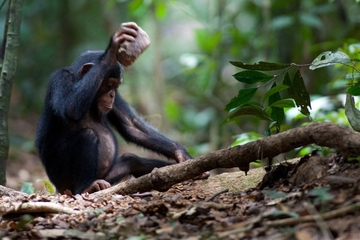
7. The chimpanzee is one of only a handful of animals that can recognise itself in a mirror.

9. Chimps communicate in a manner similar to human. They use nonverbal and verbal communication, hand gestures, and facial expressions. Research into the chimpanzee brain has revealed that chimp communication activates an area of the chimp brain that is in the same position as Broca's area, a language center in the human brain.
10. Adult chimpanzees, particularly males, can be very aggressive. They are highly territorial and are known to kill other chimps.
11. Chimpanzees also engage in targeted hunting of lower order primates such as the red colobus monkey and bush babies. They use the meat from these kills as a "social tool" within their community.
For related articles click onto the following links:
ALL ABOUT GORILLAS
CHIMPANZEE
WHAT IS A GORILLA?
For related articles click onto the following links:
ALL ABOUT GORILLAS
CHIMPANZEE
WHAT IS A GORILLA?


No comments:
Post a Comment